
The West Midlands is a substantial adult skills market, but its name hides an important distinction. The statistical region extends well beyond the seven metropolitan areas funded by the West Midlands Combined Authority (WMCA). Warwickshire has its own devolved adult skills responsibilities, while Staffordshire and Stoke-on-Trent, Worcestershire and the Marches have different commissioning arrangements.
The opportunity lies in connecting funding systems to specific employer problems. Manufacturing, construction and care recur across the region, but the missing skills range from entry-level confidence to specialist technicians, managers and digital adoption. A regional sales territory is useful; a single regional delivery proposition is less convincing.
In this article
Start with five skills systems
The five current Local Skills Improvement Plans (LSIPs) cover the WMCA area; Warwickshire; Stoke-on-Trent and Staffordshire; Worcestershire; and the Marches, covering Herefordshire, Shropshire and Telford and Wrekin. Each provides a different employer-led account of skills needs. Coventry belongs to the WMCA funding footprint, even though the chamber leading its LSIP also leads Warwickshire’s separate plan.
WMCA combines strategic influence with an integrated settlement. Warwickshire County Council took responsibility for devolved adult skills in August 2026. Elsewhere, national Adult Skills Fund (ASF) funding remains important alongside county-led Bootcamps and local employment programmes. A council’s role in commissioning Bootcamps does not establish that it controls the ASF for all its residents.
Funding geography / routes to market
Start with the commissioner, then define the catchment.
01 / Commissioning geography
WMCA adult skills system
Route to understandBravo FPS admission windows, normally six-monthly; subsequent competitions use category, place and sector filters. Register for WMCA’s FPS notifications and prepare evidence for the relevant application window.
02 / Commissioning geography
WMCA construction academies
Route to understandA 22nd May 2026 pipeline notice describes employer-based construction academies. Monitor the procurement record for the next stage and build employer-site partnerships.
03 / Commissioning geography
Warwickshire adult skills and employability
Route to understandEmployability and Skills DPS through CSW-Jets; current council guidance also directs new opportunities to Warwickshire In-Tend/Sell2Midlands. Follow the system specified for each procurement.
04 / Commissioning geography
Staffordshire and Stoke-on-Trent Bootcamps
Route to understandCouncil Bootcamps programme pages and procurement/award information. The published county grant establishes programme funding; confirm any provider invitation and deadline separately.
05 / Commissioning geography
Worcestershire skills delivery
Route to understandSkills and Investment Grant Funding DPS and council In-Tend opportunities. Check the relevant category, live notice and call-off documentation.
06 / Commissioning geography
Marches supported employment
Route to understandCtW is already delivering through named local services. Explore complementary training and referral partnerships with those teams; monitor each council for separate commissioned work.
07 / Commissioning geography
Shropshire Bootcamps pipeline
Route to understandProposed 2027/28 programme, subject to DWP funding approval. Monitor the council’s decision and procurement records; supplier applications are not established as open.
08 / Commissioning geography
National ASF in non-devolved areas
Route to understandNational funding agreements remain relevant outside WMCA and Warwickshire. Verify the agreement and learner-residency rules; local employer demand alone does not create direct funding access.
Follow the allocation, then find the accessible share
WMCA’s £155.17 million is an annual allocation for 1st April 2026 to 31st March 2027. It combines four adult skills and Bootcamp lines within the integrated settlement. It is neither a three-year total nor a single tender. The government table gives separate allocations for subsequent years; the route through grants, existing contracts and future competitions determines what a provider can pursue.
That distinction is particularly important here. WMCA’s January 2026 commissioning decision recorded the earlier approval for direct funding of 80% of adult skills grant funding to further education colleges and local authorities for academic year 2026/27. It also approved competitive commissioning of up to £42.76 million per annum from its Employment and Skills pillar over 2026 to 2029. This is a commissioning envelope within the funding system, not an extra allocation to add to the settlement.
Warwickshire’s later national grant letters show £6,925,414 core ASF, £533,133 Free Courses for Jobs (FCfJ) and £84,862 engineering funding for academic year 2026/27, a calculated £7,543,409. Its corresponding financial-year figures are shown below. Staffordshire, Warwickshire and Worcestershire each have a separate maximum £1.5 million Bootcamps grant for financial year 2026/27, including £400,000 for construction.
WMCA: adult skills: Calculated subtotalFinancial year 2026/27: 1st April 2026 to 31st March 2027 · Four adult skills and Bootcamp lines; grant-funded and competitively commissioned provision£155,171,959
| Component | Amount | Period / scope |
|---|---|---|
| ASF including FCfJ | £140,343,486 | Financial year 2026/27 |
| ASF construction uplift | £1,973,815 | Financial year 2026/27 |
| Skills Bootcamps | £9,799,844 | Financial year 2026/27 |
| Bootcamps construction | £3,054,814 | Financial year 2026/27 |
Government integrated settlement funding table. These four lines total £155,171,959; the subtotal excludes CtW and other settlement programmes.
WMCA: CtW: Published allocationFinancial year 2026/27 · WMCA employment support allocation£14,840,347
| Component | Amount | Period / scope |
|---|---|---|
| CtW | £14,840,347 | Financial year 2026/27 |
Separate line in the integrated settlement table; not included in the adult skills subtotal.
Warwickshire County Council: devolved adult skills: Calculated subtotalFinancial year 2026/27 · Core ASF, FCfJ and FCfJ engineering; first year of devolution£4,966,160
| Component | Amount | Period / scope |
|---|---|---|
| Core ASF | £4,574,370 | Financial year 2026/27 |
| FCfJ | £338,751 | Financial year 2026/27 |
| FCfJ engineering package | £53,039 | Financial year 2026/27 |
National grant letters updated on 20th August 2026. Corresponding academic year 2026/27 amounts total £7,543,409; do not add the two periods. Bootcamps are separate.
Warwickshire County Council: Skills Bootcamps: Published maximum grantFinancial year 2026/27 · Warwickshire£1,500,000
| Component | Amount | Period / scope |
|---|---|---|
| Other Bootcamps allocation, calculated | £1,100,000 | Financial year 2026/27 |
| Included construction allocation | £400,000 | Financial year 2026/27 |
National 2026/27 Bootcamps allocation table. Construction is included within £1.5 million; £1.1 million is the calculated remainder.
Staffordshire County Council: Skills Bootcamps: Published maximum grantFinancial year 2026/27 · Staffordshire and Stoke-on-Trent programme£1,500,000
| Component | Amount | Period / scope |
|---|---|---|
| Other Bootcamps allocation, calculated | £1,100,000 | Financial year 2026/27 |
| Included construction allocation | £400,000 | Financial year 2026/27 |
National 2026/27 Bootcamps allocation table. Construction is included within £1.5 million; £1.1 million is the calculated remainder.
Worcestershire County Council: Skills Bootcamps: Published maximum grantFinancial year 2026/27 · Worcestershire£1,500,000
| Component | Amount | Period / scope |
|---|---|---|
| Other Bootcamps allocation, calculated | £1,100,000 | Financial year 2026/27 |
| Included construction allocation | £400,000 | Financial year 2026/27 |
National 2026/27 Bootcamps allocation table. Construction is included within £1.5 million; £1.1 million is the calculated remainder.
Shropshire, Telford and Wrekin and Herefordshire: CtW: Published programme awardMulti-year programme announced in 2025 · Three-authority delivery area, administered by Shropshire Council£10.7 million
| Component | Amount | Period / scope |
|---|---|---|
| CtW programme | £10.7 million | Multi-year programme |
Council economic development update of 1st April 2026 confirms the combined award. This is not an annual ASF allocation or an open tender value.
The strongest propositions connect entry, technical skills and progression
The LSIPs point towards three linked offers: accessible routes into work, technical capability that employers cannot readily recruit, and progression for people already employed. A construction offer that stops at site entry overlooks supervision. A care offer that stops at recruitment overlooks retention, digital records and progression. A manufacturing offer that stops at introductory digital skills overlooks maintenance, automation and higher technical capability.
TA’s Sector Subject Area mapping below translates these needs into curriculum planning. The codes describe subject coverage rather than a list of funded qualifications. The more useful commercial test is whether an employer will recruit, release staff or change workplace practice because of the proposed learning.
Local Skills Improvement Plans / delivery implications
Translate the sector priority into an occupational offer.
WMCA area
Employer representative body: Coventry and Warwickshire Chamber of Commerce
Approved 2026 to 2029
Local priorities: Advanced manufacturing, clean technology and defence · Business, professional and financial services · Health and medtech · Creative and digital · Everyday economy
Organise the offer around six cross-cutting priorities: navigation, flexible training, foundations, management, digital adoption and green skills.
Explore occupations, capabilities and delivery implications
| Priority | What this means for provision |
|---|---|
| SSA 4: Engineering and Manufacturing TechnologiesAdvanced manufacturing, clean technology and defence | TA delivery implication: Link flexible Level 3 and higher technical modules to the production methods employers are adopting. Treat clean technology and defence as applications requiring specific equipment, standards and practical experience, rather than as separate generic course titles. |
| SSA 15: Business, Administration and LawBusiness, professional and financial services | TA delivery implication: Use first-line management as a progression opportunity: develop supervisors who can turn technical knowledge into team performance. Define the professional role and add the data, analysis or client judgement it requires. |
| SSA 1: Health, Public Services and CareSSA 4: Engineering and Manufacturing TechnologiesHealth and medtech | TA delivery implication: Keep care delivery and medical-technology pathways distinct. Combine employer-validated practical competence with the digital tools and supervisory capability the role needs; a health-sector label alone cannot establish the right learner or qualification route. |
| SSA 6: Digital TechnologySSA 9: Arts, Media and PublishingCreative and digital | TA delivery implication: Apply data and AI to real production or business tasks. Separate creative portfolios and commercial briefs from specialist digital-system skills, and show how learners can progress beyond awareness training. |
| Everyday economy | TA delivery implication: define the essential local service and job role first, then join accessible entry training to an employer-backed progression route. A broad economy label is too wide to specify a course or one SSA. |
| Technical progression | Flexible modules and progression through Level 3 and higher technical learning; connect manufacturing skills to changing production methods. |
| First-line management | Develop supervisors and managers who can translate technical capability into workforce performance. |
| Digital and green adoption | Embed data, AI and sustainability in actual occupations rather than treating them as stand-alone awareness topics. |
Warwickshire
Employer representative body: Coventry and Warwickshire Chamber of Commerce
Approved 2026 to 2029
Local priorities: Advanced manufacturing and engineering · Digital and creative · Logistics · Health and care · Tourism, hospitality and rural industries
Tailor practical digital adoption and work-integrated management to different county industries and learner catchments.
Explore occupations, capabilities and delivery implications
| Priority | What this means for provision |
|---|---|
| SSA 4: Engineering and Manufacturing TechnologiesAdvanced manufacturing and engineering | TA delivery implication: Build a visible Level 2 and 3 route towards higher technical study. Test access to specialist tutors, equipment and employer practice before promising emerging-technology provision. |
| SSA 6: Digital TechnologySSA 9: Arts, Media and PublishingDigital and creative | TA delivery implication: Combine applied technical tools with practical project work and an explicit progression step. Specialist teaching capacity and employer co-design matter when moving learners beyond introductory digital or creative training. |
| SSA 4: Engineering and Manufacturing TechnologiesSSA 7: Retail and Commercial EnterpriseLogistics | TA delivery implication: Define the driving, warehouse, planning or coordination role before choosing a programme. Use modular delivery and employer co-design to make progression feasible for staff whose release time is limited. |
| SSA 1: Health, Public Services and CareHealth and care | TA delivery implication: Join occupational competence to supervised practice and progression. Test rural travel, staff-release time and affordability with employers so that a technically suitable course can also be attended and completed. |
| SSA 3: Agriculture, Horticulture and Animal CareSSA 7: Retail and Commercial EnterpriseSSA 8: Leisure, Travel and TourismTourism, hospitality and rural industries | TA delivery implication: distinguish agricultural and land-based capability from hospitality and tourism operations. Use employer-specific practical training and flexible schedules that reflect rural travel, seasonal activity and limited staff-release capacity. |
| Technical and digital progression | Clearer Level 2 and 3 routes into higher technical study; specialist teaching capacity in emerging technologies. |
| Management and access | Modular, accessible training and employer co-design to overcome time, cost and rural participation barriers. |
Stoke-on-Trent and Staffordshire
Employer representative body: Staffordshire Chamber of Commerce and Industry
Approved 2026 to 2029
Local priorities: Advanced manufacturing and materials · Clean energy · Creative industries and crea-tech · Digital and technology · Agriculture and agri-tech · Construction · Health and social care · Advanced logistics and distribution
Link entry routes to Level 3 technical competence and the Level 4 and 5 gap highlighted in the plan.
Explore occupations, capabilities and delivery implications
| Priority | What this means for provision |
|---|---|
| SSA 4: Engineering and Manufacturing TechnologiesAdvanced manufacturing and materials | TA delivery implication: Connect the existing Level 2 to 6 manufacturing pathway to practical materials, process and quality capability. Use employer equipment and production tasks to show what each progression step enables someone to do. |
| SSA 4: Engineering and Manufacturing TechnologiesSSA 5: Construction, Planning and the Built EnvironmentClean energy | TA delivery implication: define whether the gap is engineering, installation, maintenance, retrofit or project delivery. Build on existing technical competence and validate equipment, safety and workplace requirements with employers before recruiting a new-entry cohort. |
| SSA 9: Arts, Media and PublishingCreative industries and crea-tech | TA delivery implication: use practical production briefs and portfolios to connect learning with paid work. Combine technical tools with project, pricing and client-management capability, and make delivery workable for freelancers and small creative businesses. |
| SSA 6: Digital TechnologyDigital and technology | TA delivery implication: Use software development, automation and AI in concrete occupational settings, including smart buildings and digital warehouses. Separate digital confidence from the specialist competence required to implement or troubleshoot systems. |
| SSA 3: Agriculture, Horticulture and Animal CareSSA 4: Engineering and Manufacturing TechnologiesSSA 9: Arts, Media and PublishingAgriculture and agri-tech | TA delivery implication: combine safe practical production with equipment, digital and business capability. Test seasonal release patterns and access to relevant machinery, then connect entry routes to technical or supervisory progression in local farming and food businesses. |
| SSA 5: Construction, Planning and the Built EnvironmentConstruction | TA delivery implication: Combine trade progression with construction project management and supervision. Smart-building monitoring creates a useful applied digital strand where employers can provide relevant systems and workplace tasks. |
| SSA 1: Health, Public Services and CareHealth and social care | TA delivery implication: connect care recruitment to practical competence, digital recordkeeping and progression into senior or supervisory roles. Design training around shifts and employer support so that completion can translate into sustained work. |
| SSA 4: Engineering and Manufacturing TechnologiesSSA 7: Retail and Commercial EnterpriseAdvanced logistics and distribution | TA delivery implication: Connect warehouse operations to digital systems, coordination and supervisory progression. Assess practical performance within the operating environment, while keeping accessible entry routes for learners who first need foundational or English-language support. |
| Manufacturing and construction | Manufacturing occupations at Levels 2 to 6, advanced materials capability, construction project management and supervision. |
| Digital adoption | Software development, automation, AI, smart-building monitoring and digital warehouse operations. |
| Inclusive progression | Foundational skills, ESOL and supported entry, followed by credible higher technical pathways. |
The Marches
Employer representative body: Shropshire Chamber of Commerce
Approved 2026 to 2029
Local priorities: Manufacturing and engineering · Health and social care · Construction
Combine specialist technical training with local access, employer release and practical progression.
Explore occupations, capabilities and delivery implications
| Priority | What this means for provision |
|---|---|
| SSA 4: Engineering and Manufacturing TechnologiesManufacturing and engineering | CNC machining, welding, fabrication, assembly, automation and robotics. |
| SSA 1: Health, Public Services and CareHealth and social care | TA delivery implication: Connect entry care competence to Level 3 progression, digital care records and supervision. Design employer-supported practice and delivery schedules that work across dispersed communities. |
| SSA 5: Construction, Planning and the Built EnvironmentConstruction | TA delivery implication: Build retrofit and modern-construction capability on sound trade fundamentals. Use local employer partnerships and flexible delivery to address the practical equipment and travel requirements of dispersed firms. |
| Care and construction | Care progression towards Level 3, digital care records, supervision, retrofit and modern construction methods. |
| Cross-cutting capability | Employability and digital transformation across dispersed employers and communities. |
Worcestershire
Employer representative body: Herefordshire and Worcestershire Chamber of Commerce
Approved 2026 to 2029
Local priorities: Health and social care · Construction · Manufacturing and engineering
Treat getting into work and progression at work as connected but distinct curriculum and employer-support needs.
Explore occupations, capabilities and delivery implications
| Priority | What this means for provision |
|---|---|
| SSA 1: Health, Public Services and CareHealth and social care | TA delivery implication: Test care employers’ specific occupational and progression requirements alongside the profile’s wider emphasis on communication, organisation and digital confidence. Build manager support into delivery so that learning changes practice at work. |
| SSA 5: Construction, Planning and the Built EnvironmentConstruction | TA delivery implication: Make the progression from trade competence to site supervision and management explicit. Add workplace communication and organisation, with supervisors reinforcing the skills between training sessions. |
| SSA 4: Engineering and Manufacturing TechnologiesManufacturing and engineering | TA delivery implication: Connect technician and engineering competence to higher-level progression. Practical leadership and train-the-trainer support can help employers sustain development after the taught programme ends. |
| Technical progression | Construction progression from trades towards supervision and management; manufacturing technician and engineering capability through higher levels. |
| Everyday employability | Communication, organisation, digital confidence and workplace behaviours, reinforced by managers and supervisors. |
| Business resilience | Practical leadership and business capability, with train-the-trainer support to strengthen in-house development. |
LSIP evidence to curriculum
A sector label becomes useful when it changes the course.
Across all five LSIP footprints
Engineering and manufacturing
4.1 Engineering · 4.2 Manufacturing technologies
Build a progression ladder from operative competence to maintenance, automation and higher technical capability.
WMCA, Staffordshire, Worcestershire and the Marches
Construction and the built environment
5.2 Building and construction
Connect entry training to a real site, then show how experienced workers progress into supervision and low-carbon practice.
All five footprints
Health and social care
1.3 Health and social care
Pair recruitment with digital care practice and progression so training addresses retention as well as vacancies.
WMCA and Warwickshire clusters; cross-sector need throughout
Digital practice and adoption
6.1 Digital technology (practitioners) · 6.2 Digital technology (users)
Separate specialist digital careers from the everyday data and AI skills needed in existing occupations.
Staffordshire and Warwickshire
Logistics and transport
7.2 Warehousing and distribution · 4.3 Transportation operations and maintenance
Link warehouse and transport skills to changing equipment, digital systems and workplace progression.
All five footprints
Leadership and management
15.3 Business management
Make management learning solve an operational problem and secure employer time to apply it.
Urban neighbourhoods and dispersed county catchments
Foundations and employability
14.1 Foundations for learning and life · 14.2 Preparation for work
Design the route into learning with the same precision as the route into employment.
TA crosswalk to Ofqual Sector Subject Areas. The qualification’s assigned SSA and the programme’s eligibility rules remain the classification reference.
Design the learner journey around the actual catchment
Use neighbourhood deprivation alongside travel times, learner starting points and job locations. A city-wide average can hide substantial differences between a training venue and the communities expected to reach it. In dispersed county markets, a modest cohort can still require several referral networks and a delivery model that accommodates transport and caring responsibilities.
The Warwickshire and Marches LSIPs identify rural access barriers; Staffordshire’s plan connects entry pathways with employment, health and community support. Build these considerations into the costed model: accessible induction, realistic attendance patterns, digital access, employer release time and a named progression destination. Recruitment volume becomes more credible when the route into learning is as specific as the curriculum.
English Indices of Deprivation 2025
Local disadvantage changes the delivery model.
16.0% of the region’s neighbourhoods are in England’s most deprived tenth: 573 of 3,574 LSOAs. The concentration differs substantially between council areas.
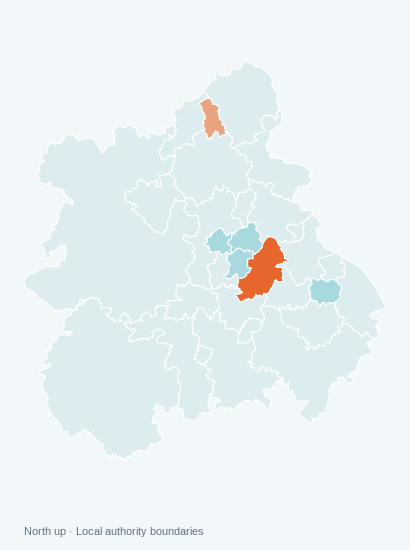
Compare all 30 council areas: exact counts and education deprivation
| Council area | All LSOAs | Overall IMD decile 1 | Education domain decile 1 |
|---|---|---|---|
| Birmingham | 659 | 282 (42.8%) | 191 (29.0%) |
| Stoke-on-Trent | 163 | 47 (28.8%) | 48 (29.4%) |
| Walsall | 169 | 42 (24.9%) | 53 (31.4%) |
| Wolverhampton | 161 | 35 (21.7%) | 17 (10.6%) |
| Coventry | 203 | 36 (17.7%) | 20 (9.9%) |
| Sandwell | 190 | 31 (16.3%) | 44 (23.2%) |
| Solihull | 134 | 18 (13.4%) | 17 (12.7%) |
| Telford and Wrekin | 115 | 15 (13.0%) | 16 (13.9%) |
| Worcester | 64 | 8 (12.5%) | 11 (17.2%) |
| Tamworth | 51 | 6 (11.8%) | 8 (15.7%) |
| Dudley | 203 | 22 (10.8%) | 36 (17.7%) |
| Nuneaton and Bedworth | 84 | 7 (8.3%) | 15 (17.9%) |
| Wyre Forest | 67 | 5 (7.5%) | 10 (14.9%) |
| Redditch | 57 | 4 (7.0%) | 14 (24.6%) |
| East Staffordshire | 72 | 4 (5.6%) | 14 (19.4%) |
| Cannock Chase | 61 | 2 (3.3%) | 7 (11.5%) |
| North Warwickshire | 38 | 1 (2.6%) | 5 (13.2%) |
| Newcastle-under-Lyme | 80 | 2 (2.5%) | 4 (5.0%) |
| Malvern Hills | 45 | 1 (2.2%) | 1 (2.2%) |
| Stafford | 81 | 1 (1.2%) | 2 (2.5%) |
| Warwick | 88 | 1 (1.1%) | 2 (2.3%) |
| Shropshire | 198 | 2 (1.0%) | 11 (5.6%) |
| Herefordshire, County of | 117 | 1 (0.9%) | 5 (4.3%) |
| Bromsgrove | 60 | 0 (0.0%) | 2 (3.3%) |
| Lichfield | 62 | 0 (0.0%) | 2 (3.2%) |
| Rugby | 67 | 0 (0.0%) | 1 (1.5%) |
| South Staffordshire | 68 | 0 (0.0%) | 1 (1.5%) |
| Staffordshire Moorlands | 59 | 0 (0.0%) | 2 (3.4%) |
| Stratford-on-Avon | 77 | 0 (0.0%) | 0 (0.0%) |
| Wychavon | 81 | 0 (0.0%) | 3 (3.7%) |
Each measure uses its own national ranking. These are neighbourhood shares, not population poverty rates or assessments of individual learners. A zero does not mean an absence of disadvantage.
TA calculations from corrected MHCLG IoD2025 File 7 and ONS 2024 authority geography. 3,574 neighbourhoods (2021 LSOAs) in this region. Contains OS data and National Statistics data © Crown copyright and database right 2026.
WMCA: secure access before the relevant competition
The Flexible Procurement System (FPS), established in December 2025, is the main published access route for WMCA skills competitions. Application windows normally open every six months, with additional specialist windows possible. Providers join through Bravo and select relevant categories, places and sectors; those filters determine which further competitions they can receive.
An FPS application is therefore a market-positioning exercise. Match each selection to proven delivery, named employer relationships and operational capacity. WMCA also publishes a construction academy pipeline: employer-based delivery in real working environments is a useful signal for partnership development, rather than evidence that a tender is currently open.
Admission tests delivery capacity before a funded competition begins. In the Round 2 application pack, four technical and professional ability answers had to achieve at least 20 points out of 40 in total. For each assessed delivery category, both category answers needed at least 6/10. A strong answer on one could not compensate for failing the other. Financial, insurance, quality, safeguarding and regulatory checks were separate requirements.
A second admission round closed on 31st March 2026. It gave providers another opportunity to establish eligibility, including those improving an earlier application, while retaining demanding entry requirements. Prepare evidence and supporting policies before the next window. The five categories below describe different delivery propositions; four require category-specific assessed responses, while successful admission includes Innovation automatically.
Five FPS categories, four assessed delivery propositions
Choose the resident outcome you can deliver, then evidence the capacity to achieve it.
| Category | Delivery implication |
|---|---|
| Building strong and inclusive communities | Accessible first steps in learning, confidence, language, numeracy and digital skills, connected to progression. |
| Providing a good education up to Level 2 | Foundation and vocational learning that adults can fit around work and other responsibilities. |
| Moving residents into employment and supporting career progression | Employer-linked training, sustainable work and progression out of low pay, backed by practical learner support. |
| Meeting future skills needs at Level 3 and above through upskilling and reskilling | Technical, higher-level and management capability linked to regional demand, with flexible access for people in work. |
| Innovation | New approaches to learning and employment support; included automatically when a provider joins the FPS. |
Warwickshire: a new commissioner with an established supplier route
Warwickshire’s devolved role makes August 2026 a genuine change in the market. Its LSIP calls for work-integrated leadership development, practical digital and AI confidence, clearer entry routes and modular delivery. Advanced engineering around Gaydon, the Silicon Spa games cluster, logistics and rural employers create different requirements within one county.
The council operates an Employability and Skills DPS. Its current procurement guidance distinguishes the newer Warwickshire In-Tend portal from the former CSW-Jets system, which continues to administer various DPS admissions and call-offs. Check both the particular procurement record and the supplier account carrying it. The advertised £60 million DPS estimate is a multi-year procurement estimate, not Warwickshire’s annual ASF budget.
Staffordshire and Stoke-on-Trent: build the technical ladder
The LSIP identifies eight sector priorities, including advanced manufacturing and materials, clean energy, digital, creative industries, agriculture, construction, care and advanced logistics. Its most distinctive emphasis is progression: Level 2 entry routes, Level 3 technical capability and a stronger Level 4 and 5 offer. Short courses should fit into that ladder rather than become isolated interventions.
Staffordshire County Council leads the local Bootcamps programme covering Staffordshire and Stoke-on-Trent. Follow its programme pages alongside procurement and award records. Keele’s current Leadership in the Green Economy Bootcamp illustrates the breadth of provision already present: a hybrid, applied management offer sits alongside the area’s technical and entry-level needs.
An email list can be the route to the application. In its reply to TA on 24th June 2026, Staffordshire County Council confirmed that Wave 7 applications had closed and delivery had begun. It also corrected its own website: the statement requiring approved framework membership had been published in error. The council had used an advance application process, with papers issued through its mailing list.
The council expected to consider a similar approach for a further wave, subject to securing funding, and indicated late 2026 or early 2027 as a possible application period. That was an expectation, not a confirmed launch. Providers should join the programme mailing list and seek the current timetable instead of waiting for a conventional tender notice.
Worcestershire: combine technical delivery with everyday capability
Worcestershire’s three LSIP sector priorities are health and social care, construction, and manufacturing and engineering. Everyday employability and business resilience cut across them. The plan distinguishes getting into work from getting on at work, including a train-the-trainer approach that helps managers and supervisors develop workplace and digital capability.
The county’s Skills and Investment Grant Funding DPS provides a route for relevant commissioned activity, with opportunities administered through In-Tend. Its Bootcamps allocation should be considered alongside existing provision: Workpays has a construction Bootcamp listing in Redditch, while Heart of Worcestershire College advertises a Level 2 digital and IT course there. Differentiate by employer demand, progression and access, rather than simply adding another course title.
The Marches: local reach matters as much as course breadth
The Marches LSIP concentrates on manufacturing and engineering, construction, and care, supported by employability and digital transformation. CNC machining, welding and automation sit alongside care progression and construction supervision. A portable teaching offer can help, but workshop access and travel arrangements still shape participation.
Shropshire administers Connect to Work (CtW) across Shropshire, Telford and Wrekin and Herefordshire. The published programme award is £10.7 million across the three areas, with delivery through Enable, Job Box and Herefordshire’s Youth Employment Hub. For training providers, this makes referral and complementary skills partnerships a practical avenue alongside direct procurement monitoring.
WMCA’s live Connect to Work procurement covers Walsall, Wolverhampton and Sandwell, with an estimated value of £18.93 million excluding VAT. The full notice gives a submission deadline of noon on 1st December 2026; a conflicting summary date requires portal confirmation. See the opportunity note for the current position. This procurement value is separate from the regional funding allocations.
Shropshire is also preparing a separate Skills Bootcamps programme for its own council area. Cabinet approved the approach on 14th October 2026. The report proposes approximately £1.5 million for 1st April 2027 to 31st March 2028, including £400,000 for construction, with a DWP funding decision expected in December 2026. This is proposed funding, excluded from the confirmed allocation table. External provider commissioning is planned, but these papers do not establish an open tender. Providers should prepare employer-backed offers and rural delivery arrangements, then monitor the funding decision and procurement documents.
Herefordshire Council’s published forward plan proposes submitting a delivery plan for £1.5 million of Skills Bootcamps funding for financial year 2027/28, with the council managing and commissioning delivery following DWP approval. The council’s issue page now schedules the decision for 9th December 2026, with the proposal still awaiting determination. Treat this as a pipeline proposal: prepare a local employer case and follow the funding decision and provider-selection route. The proposed amount is excluded from the confirmed allocation table.
Separate commissioners from local delivery partners
The seven WMCA constituent councils remain important for neighbourhood access, adult learning and employer connections. Warwickshire, Staffordshire and Worcestershire county councils operate alongside district and borough councils whose local relationships can strengthen recruitment. Stoke-on-Trent, Herefordshire, Shropshire and Telford and Wrekin have unitary councils.
Use the directory to assign market monitoring and relationship development. District economic development teams can help identify vacancies, premises and referrals where skills contracts sit with a county, combined authority or national funder.
On 29th October 2026, government withdrew the July Staffordshire and Stoke-on-Trent reorganisation decision. Warwickshire and Worcestershire each have a provisional two-council proposal, subject to representations, final decisions and Parliamentary approval. Continue working with current commissioners while monitoring the transition. The further representation period for Warwickshire and Worcestershire runs from 23rd November to 14th December 2026. Final decisions remain outstanding.
Buyer and delivery geography
Find the lead. Build the local delivery relationships.
Choose a shaded area or a commissioning geography below to see the programme lead and local council network.
Select a numbered area
Selected geography
WMCA
- Programme lead
- WMCA: devolved ASF and Bootcamps; Bravo FPS.
- Delivery and access
- Seven constituent metropolitan areas. WMCA leads devolved adult skills; councils also provide local services, learning and access partnerships.
- Local council network
- Birmingham · Coventry · Dudley · Sandwell · Solihull · Walsall · Wolverhampton
Complete directory: 30 council areas
| Council area | Upper-tier area | Commissioning geography |
|---|---|---|
| Birmingham | Birmingham | WMCA |
| Bromsgrove | Worcestershire | Worcestershire |
| Cannock Chase | Staffordshire | Staffordshire and Stoke-on-Trent |
| Coventry | Coventry | WMCA |
| Dudley | Dudley | WMCA |
| East Staffordshire | Staffordshire | Staffordshire and Stoke-on-Trent |
| Herefordshire, County of | Herefordshire, County of | The Marches |
| Lichfield | Staffordshire | Staffordshire and Stoke-on-Trent |
| Malvern Hills | Worcestershire | Worcestershire |
| Newcastle-under-Lyme | Staffordshire | Staffordshire and Stoke-on-Trent |
| North Warwickshire | Warwickshire | Warwickshire |
| Nuneaton and Bedworth | Warwickshire | Warwickshire |
| Redditch | Worcestershire | Worcestershire |
| Rugby | Warwickshire | Warwickshire |
| Sandwell | Sandwell | WMCA |
| Shropshire | Shropshire | The Marches |
| Solihull | Solihull | WMCA |
| South Staffordshire | Staffordshire | Staffordshire and Stoke-on-Trent |
| Stafford | Staffordshire | Staffordshire and Stoke-on-Trent |
| Staffordshire Moorlands | Staffordshire | Staffordshire and Stoke-on-Trent |
| Stoke-on-Trent | Stoke-on-Trent | Staffordshire and Stoke-on-Trent |
| Stratford-on-Avon | Warwickshire | Warwickshire |
| Tamworth | Staffordshire | Staffordshire and Stoke-on-Trent |
| Telford and Wrekin | Telford and Wrekin | The Marches |
| Walsall | Walsall | WMCA |
| Warwick | Warwickshire | Warwickshire |
| Wolverhampton | Wolverhampton | WMCA |
| Worcester | Worcestershire | Worcestershire |
| Wychavon | Worcestershire | Worcestershire |
| Wyre Forest | Worcestershire | Worcestershire |
District and borough boundaries follow ONS December 2024 geography. Programme leads are described separately from councils that help recruit, support and connect learners. Contains OS and National Statistics data © Crown copyright and database right 2026.
Map competitors by what they can already deliver
The region combines established college infrastructure, specialist independent providers, universities and public employment services. The examples below distinguish published provision and institutional plans from contract awards. They identify organisations to examine, rather than a ranking of market share.
Ask what existing providers cover, where learners struggle to progress and which employers remain underserved. Facilities, referrals and specialist tutors can make an incumbent a useful partner. Explain the additional capability your partnership would create.
TA obtained the names of 205 organisations admitted to the FPS through Freedom of Information request FOI4241, answered on 30th September 2026. The mix of colleges, specialist providers, universities, charities and community organisations shows why strategy needs more precision than simply identifying who is on the system.
Use the directory to investigate potential competitors and delivery partners. WMCA withheld each supplier’s category, sector and place selections on commercial-interest grounds. Those filters narrow the field at call-off stage, so the full membership list is not the bidder list for any one competition.
Explore the 205 FPS organisations disclosed to TA
| Organisation admitted to the FPS |
|---|
| 2mrw Training |
| 3 Counties Accounts and Training Services |
| 3 Spirit Training |
| 3D 360 Limited |
| Access to Business |
| Acorn Training Ltd |
| Aim2Learn |
| AKG UK Learning Ltd |
| Alphabet Training |
| Althaus Training |
| Archon Academy |
| Aronex College |
| Ashiana Community Project |
| Ashley Community Housing Ltd |
| Aspire Sporting Academy |
| Aspire Training Solutions UK Ltd |
| Avision for Empowerment |
| B-Skill Limited |
| Back 2 Work Complete Training Ltd |
| Baltic Apprenticeships |
| Bath Spa University |
| Beacon Education Partnership Ltd |
| Beam up |
| Best Practice Network Ltd |
| Birmingham City University |
| Blue Building Services |
| Blue Sky Assessing & Consultancy Ltd |
| BOM (Birmingham Open Media) |
| Bosnia and Herzegovina UK Network |
| BPIF Training Limited |
| Bright Direction Training |
| BritAsia TV |
| Business 2 Business UK |
| Career Group Courses |
| Carter Holdings |
| Castleview Group Training Ltd |
| Cecos Computing International |
| Cenit College UK LTD |
| Central Building and Welding Academy |
| Challenge-trg Skills Ltd |
| Cherat Careers |
| Civil Ceremonies |
| Code Institute |
| Colebridge Trust |
| Community Training Portal |
| Corporation of NCG |
| Coventry and Warwickshire Chamber of Commerce Training |
| CRACKERJACK TRAINING LTD |
| Creative Alliance |
| Crosby Management |
| CSR Scientific Training Limited |
| Derby Business College Ltd T/A DBC Training |
| Digital Innov8ors |
| DMR Training and Consultancy Ltd |
| Dudley College of Technology |
| Dulson Training Ltd |
| Eagles Consultancy |
| East Birmingham Community Forum |
| Educ8 Training Group Limited |
| Elec Training |
| Endorphins Group |
| Enterkey Training Limited |
| Enterprise 4 all |
| Environmental Excellence Training and Development Ltd |
| Fairfield School of Business |
| Fairway Training Healthcare Ltd |
| Fareport Training |
| Form Leadership |
| FTW Training |
| Future Connect Training & Recruitment Ltd |
| Futures Advice Skills and Employment |
| Generation |
| Get Skills Employment and Training |
| Heart and Soul Community |
| Hercules Site Services Training Ltd |
| HIT Training Limited |
| House Builder XL Ltd |
| Humanise Solutions |
| Hybrid Technical |
| I&F Limited |
| Ideal for All |
| Imeta Training and Solutions Ltd |
| In The Community Ltd |
| In-Comm Training |
| Innovate Learning CIC |
| Integer Training |
| Intertrain UK Ltd |
| IOSphere |
| Iungo solutions |
| JBC Skills Training Ltd |
| JCL Skills Solutions |
| JGA Ltd |
| Job Change |
| JTL |
| Juniper Training Ltd |
| Just IT Training Limited |
| Just Straight Talk |
| Kaplan Financial |
| Keir Training and Recruitment |
| LD Training |
| Learning Curve Group Limited |
| Learning for Change Academy |
| Learning into Employment Academy |
| Let me Play |
| Local Education and Development Limited |
| London School of Science and Technology |
| Magna College |
| MAINSTREAM TRAINING LIMITED |
| Make UK |
| Mantra Learning Ltd |
| Martinex Ltd |
| Mastered Studios |
| Maximus UK Services Limited |
| Medex Group |
| Miss Macaroon |
| Mission Accomplished |
| Momentic |
| Momentum |
| Multicultural Apprenticeships |
| National Infrastructure Solutions Ltd |
| Netcom Training Ltd |
| New Generation Training & Consultancy (NGTC) Ltd |
| Niyo Group |
| North Warwickshire and South Leceistershire College |
| Northwest Education and Training Limited |
| Orangebox Training Solutions UK Limited |
| P. Flannery Plant Hire (Oval) |
| P.T.P Training |
| Parker Enterprise |
| Pathway First |
| Personal Trainer |
| Pertemps Recruitment Partnership Ltd |
| PET-Xi Training |
| Peter Smythe Transport Training |
| Pilot IMS |
| Primed Talent |
| Realise Learning and Employment Limited |
| Reed in Partnership |
| Release Potential Ltd |
| Resurgo Trust |
| RMF Construction Training Academy Ltd |
| Role Training |
| SCCU Group |
| School of Professional Studies |
| SCL Education Group |
| Seetec Business Technology Centre Ltd |
| Serco Ltd |
| SILVA BROTHERS LOGISTICS LTD |
| SJA Training |
| Skills Ladder |
| Skills Max Academy |
| Skills Solutions Group |
| Skills-Uk Education & Training |
| Smart Gas Training |
| Sport 4 Life |
| Sport Structures Education Community Interest Company |
| Square Skills |
| St Giles Trust |
| Staff Power Training |
| Standguide Ltd |
| Step Ahead Social Enterprise CIC |
| Street League |
| Strive Training |
| Sutton Coldfield Training Limited |
| Swarm Training |
| SWEDA |
| Swift ACI |
| Sysco Business Skills Academy Ltd |
| Talented Training Ltd |
| Teach a Trade |
| Teach Vocation Group Ltd |
| The Construction Skills people |
| The Development Manager |
| The Football League |
| The Growth Company |
| The Mentoring Project |
| The Portland Training Company Limited |
| The Prince's Trust |
| The Rail Futures Network Limited |
| The Railsafe Group |
| The Salvation Army |
| The Shaw Trust Limited |
| The Skills Centre London Limited |
| The Skills Network |
| The Square Metre Group |
| Think Employment Ltd |
| TLC College |
| Total Futures Ltd |
| Training Personified |
| Training Strategies |
| Trans4m Training Ltd |
| Transworld Publications |
| TRN (Train) Ltd |
| UK Graduate |
| University of Wolverhampton |
| University of Worcester |
| Unyte Academy |
| Vivid Ed |
| We are Digital |
| Weston College of Further and Higher Education |
| Women's Work Lab CIC |
| Womens Wellbeing |
| Workpays Limited |
| WYK Group |
| Xyrius Training Limited |
WMCA FOI4241, 30th September 2026. Names as disclosed, including source spellings. FPS membership does not establish a contract award or individual category, sector or place selections.
Current provision and institutional capability, checked October 2026
| Provider | Role / evidence |
|---|---|
| Dudley College of Technology | 2026/27 accountability statement aligns planned provision with the LSIP and West Midlands Growth Plan; established college infrastructure to assess for partnership. |
| Walsall College | Current college page advertises WMCA-funded adult courses; evidence of published provision rather than an allocation amount. |
| BMet | 2026/27 accountability statement records collaboration with WMCA and other colleges; current strategic capability evidence. |
| WCG | College group advertises adult learning, apprenticeships and higher education across Warwickshire and Worcestershire campuses. |
| Keele University | Leadership in the Green Economy Bootcamp started on 3rd September 2026; university page describes applied hybrid delivery. |
| Workpays | National course directory lists a construction Bootcamp at its Redditch location, updated on 7th September 2026. |
| Heart of Worcestershire College | National course directory lists Level 2 Digital and IT Skills at Redditch; evidence of local course provision. |
Provider publications, accountability statements and the national course directory. These examples do not establish award value, market share or an available subcontract.
Marches CtW delivery network
| Organisation | Role / evidence |
|---|---|
| Enable | Named Shropshire employment specialist service. |
| Job Box | Named Telford and Wrekin employment specialist service. |
| Herefordshire Youth Employment Hub | Named Herefordshire employment specialist service. |
Shropshire Council’s current programme page identifies the local delivery contacts; these are supported-employment services rather than an ASF provider allocation list.
Five actions before committing delivery capacity
Build a short commercial plan for one funding footprint and one occupational pathway first.
- Check learner postcodes against the actual funder’s geography before calculating a cohort or selecting an employer catchment.
- For WMCA, prepare FPS evidence and review category, sector and place selections before the next application window.
- For Warwickshire, reconcile the new ASF role with the specific DPS or tender route being used for the intended programme.
- Use the LSIP to ask employers which tasks, qualifications and progression points are missing, then test release time, recruitment commitments and delivery location.
- Identify an existing provider or employment-service partner where facilities, referrals or supported employment expertise would materially improve outcomes.
TA’s view: choose the progression gap, then assemble the route
The region rewards a precise offer. WMCA provides scale, Warwickshire offers a newly localised commissioning relationship, and the surrounding counties contain distinct technical and inclusion needs. The credible proposition brings together a verified funding route, an employer-defined skill gap and a practical way for local residents to reach the resulting work.
Sources and scope
Evidence checked on 21st October 2026 using the five approved 2026 to 2029 LSIPs, national allocation and grant publications, council commissioning records and current provider information. Academic-year and financial-year amounts remain separate. Procurement routes do not imply a currently open call. Warwickshire’s published FCfJ summary is £1 lower than its payment-split table; the summary amount is used consistently. Provider examples show the evidence described, not a complete award register. The 21st October update also incorporates dated TA correspondence and buyer-issued procurement material where identified in the article; individual contacts and client identities are omitted. The FPS organisation directory is the name-only disclosure in WMCA FOI4241, dated 30th September 2026. Shropshire Bootcamps pipeline updated on 22nd October 2026 from the 14th October Cabinet report and decision; other sections retain their stated review date.
Continue the thinking
England’s skills sectors
Compare the national picture across all 15 subject areas.
What makes local delivery credible?
Turn your chosen geography into a convincing delivery case.
Shape the opportunity before the tender
Use buyer engagement to test and strengthen your proposition.