
The South West rewards providers that can turn regional specialisms into a practical local delivery offer. Aerospace, cyber security, marine engineering, nuclear and low-carbon energy sit alongside substantial everyday demand in care, construction, logistics, food production and hospitality. The commercial question is which employer need, learner catchment and funding route fit together.
Start with seven LSIP areas, then redraw the map around the buyer. North Somerset shares an LSIP with the West of England but has not yet completed accession to its combined authority. Plymouth shares Greater Devon’s skills plan and Bootcamp programme but sits outside Devon and Torbay’s devolved Adult Skills Fund (ASF). A regional label alone does not settle resident eligibility or who can commission your course.
In this article
One region, several commissioning systems
West of England Combined Authority (WECA) controls a single adult skills allocation for Bristol, Bath and North East Somerset and South Gloucestershire. Cornwall Council and Devon and Torbay Combined County Authority (DTCCA) have their own devolved ASF arrangements, with separately identified Free Courses for Jobs (FCfJ) funding. Elsewhere, national ASF funding and local Bootcamp or employment programmes remain separate routes.
The LSIP leads are Business West for Gloucestershire, Somerset, Swindon and Wiltshire, and West of England with North Somerset; Dorset Chamber for Dorset; Devon Chamber for Greater Devon; and the Federation of Small Businesses for Cornwall and the Isles of Scilly. The former Heart of the South West footprint should no longer be used as one current LSIP market.
Funding geography / routes to market
Start with the commissioner, then define the catchment.
01 / Commissioning geography
West of England
Route to understandAtamis administered UPN-00266, the twelve-lot 2026 Bootcamp tender. July submissions are closed; monitor award information and later commissioning. The October 2026 decision endorses an outcomes-led commissioning direction for 2027/28 to 2035/36; prepare evidence of learner outcomes and value for money.
02 / Commissioning geography
North Somerset
Route to understandTreat current resident eligibility separately from WECA. Monitor the legal accession date and resulting funding guidance.
03 / Commissioning geography
Gloucestershire
Route to understand2026/27 Bootcamp grant confirmed. The 14th October decision remained subject to call-in until its 22nd October effective date; establish the delivery and supplier-entry route with the council.
04 / Commissioning geography
Swindon and Wiltshire
Route to understandWork Wiltshire invites interest for Wave 8 from April 2027, with a competitive-grant information event on 12th January 2027. This is early engagement, not an open tender.
05 / Commissioning geography
Somerset, Dorset and BCP
Route to understandStep Up Somerset publishes Wave 7 approved projects. The Dorset and Somerset Training Provider Network is a programme contact; ask about future calls and unmet sector needs.
06 / Commissioning geography
Devon and Torbay
Route to understandGrant allocations are published. ASF/FCfJ contracted provision uses a further competition under the DCC Skills Framework; check admission and call-off arrangements.
07 / Commissioning geography
Plymouth
Route to understandNational ASF arrangements remain relevant for Plymouth residents. Train4Tomorrow and CtW cover Plymouth with Devon and Torbay.
08 / Commissioning geography
Cornwall and Isles of Scilly
Route to understandMonitor Cornwall DPS DN753886 and its call-offs through the council’s ProContract route. Confirm each programme’s island coverage and eligibility directly.
Follow the programme, period and eligible residents
The useful distinction is between the funding authority and the opportunity a provider can enter. WECA, DTCCA and Cornwall commission devolved adult skills; several Bootcamp programmes cover a wider or different geography. Match your proposed learners to the relevant programme before investing in premises, staff or employer commitments.
Dorset and Bournemouth, Christchurch and Poole participate in the Dorset and Somerset Bootcamp programme. The national table names Somerset as the grant area. Follow that shared commissioning route while building local delivery relationships across the three council areas.
WECA: Calculated subtotal of four published componentsAcademic year 2026/27 · Bristol, Bath and North East Somerset and South Gloucestershire£21,112,475
| Component | Amount | Period / scope |
|---|---|---|
| ASF core | £15,324,411 | Academic year 2026/27 |
| Skills Bootcamps | £4,226,860 | Academic year 2026/27 |
| FCfJ excluding engineering | £1,377,754 | Academic year 2026/27 |
| Engineering package | £183,450 | Academic year 2026/27 |
National grant determination, Annexes A and B. Components sum to £1 more than the published single-allocation total before engineering.
DTCCA: Calculated subtotalAcademic year 2026/27 · ASF, FCfJ and engineering for eligible Devon and Torbay residents£13,284,206
| Component | Amount | Period / scope |
|---|---|---|
| ASF core | £12,224,008 | Academic year 2026/27 |
| FCfJ excluding engineering | £909,451 | Academic year 2026/27 |
| FCfJ engineering | £150,747 | Academic year 2026/27 |
National ASF and foundation-authority FCfJ grant determinations. Plymouth is outside this resident funding area.
Cornwall Council: adult skills: Calculated subtotalAcademic year 2026/27 · Cornwall devolved adult skills£10,978,451
| Component | Amount | Period / scope |
|---|---|---|
| ASF core | £9,962,795 | Academic year 2026/27 |
| FCfJ excluding engineering | £895,984 | Academic year 2026/27 |
| FCfJ engineering | £119,672 | Academic year 2026/27 |
Uses the published summary ASF allocation and separately ring-fenced FCfJ lines. Separate Bootcamp grant below.
Devon County Council: Skills Bootcamps: Published grant allocationFinancial year 2026/27 · Devon programme serving Devon, Plymouth and Torbay£3,300,000
| Component | Amount | Period / scope |
|---|---|---|
| General Bootcamp element, calculated | £2,500,000 | Financial year 2026/27 |
| Included ring-fenced construction element | £800,000 | Financial year 2026/27 |
National 2026/27 Bootcamp allocation. Construction is part of the £3.3 million total.
Cornwall Council: Skills Bootcamps: Published grant allocationFinancial year 2026/27 · Cornwall grant area£1,500,000
| Component | Amount | Period / scope |
|---|---|---|
| General Bootcamp element, calculated | £1,100,000 | Financial year 2026/27 |
| Included ring-fenced construction element | £400,000 | Financial year 2026/27 |
Separate financial-year grant; not added to the academic-year adult skills subtotal.
Gloucestershire County Council: Skills Bootcamps: Published grant allocationFinancial year 2026/27 · Gloucestershire£1,500,000
| Component | Amount | Period / scope |
|---|---|---|
| General Bootcamp element, calculated | £1,100,000 | Financial year 2026/27 |
| Included ring-fenced construction element | £400,000 | Financial year 2026/27 |
National 2026/27 Bootcamp allocation. Council decision published on 14th October, with effect from 22nd October 2026.
Somerset: Dorset and Somerset Skills Bootcamps: Published grant allocationFinancial year 2026/27 · Grant area labelled Somerset; shared programme includes Dorset and BCP£1,500,000
| Component | Amount | Period / scope |
|---|---|---|
| General Bootcamp element, calculated | £1,100,000 | Financial year 2026/27 |
| Included ring-fenced construction element | £400,000 | Financial year 2026/27 |
National allocation and shared Wave 7 approved-course directory. No additional Dorset allocation is assumed.
Wiltshire and Swindon: Skills Bootcamps: Published grant allocationFinancial year 2026/27 · Wiltshire Council-led programme covering both unitary areas£1,500,000
| Component | Amount | Period / scope |
|---|---|---|
| General Bootcamp element, calculated | £1,100,000 | Financial year 2026/27 |
| Included ring-fenced construction element | £400,000 | Financial year 2026/27 |
National 2026/27 Bootcamp allocation. Early provider interest is being invited for Wave 8 from April 2027.
Translate sector ambition into a teachable shortage
The strongest technical proposition combines an established occupation with its changing tools: an electrician installing low-carbon systems, an engineering technician using automation, a care worker using digital records, or a supervisor managing a more diverse workforce. Selling an isolated green or AI course is weaker than showing which job becomes more productive and how the employer will recognise that improvement.
The LSIP summaries below identify specific needs. The SSA graphic is TA’s curriculum crosswalk, rather than an official allocation formula. Use it to connect existing provision to the relevant local evidence, then check qualification eligibility and the buyer’s actual specification.
Local Skills Improvement Plans / delivery implications
Translate the sector priority into an occupational offer.
West of England and North Somerset
Employer representative body: Business West
Current published LSIP, 2026 to 2029 cycle
Local priorities: Advanced manufacturing · Clean energy · Creative · Digital · Health and care · Childcare and education · Construction · Transport and logistics
Connect technical specialisms with workplace experience and existing trade progression.
Explore occupations, capabilities and delivery implications
| Priority | What this means for provision |
|---|---|
| SSA 4: Engineering and Manufacturing TechnologiesAdvanced manufacturing | Engineering, maintenance and CAD technicians; practical factory experience, quality and digital manufacturing. |
| SSA 4: Engineering and Manufacturing TechnologiesSSA 5: Construction, Planning and the Built EnvironmentClean energy | TA delivery implication: define whether the gap is engineering, installation, maintenance, retrofit or project delivery. Build on existing technical competence and validate equipment, safety and workplace requirements with employers before recruiting a new-entry cohort. |
| SSA 9: Arts, Media and PublishingCreative | TA delivery implication: use practical production briefs and portfolios to connect learning with paid work. Combine technical tools with project, pricing and client-management capability, and make delivery workable for freelancers and small creative businesses. |
| SSA 6: Digital TechnologyDigital | TA delivery implication: distinguish everyday workplace digital confidence from specialist software, data, cyber or infrastructure capability. Assess learners through practical tasks and employer projects, with a clear next step beyond introductory awareness training. |
| SSA 1: Health, Public Services and CareHealth and care | TA delivery implication: Connect care practice to registered-manager development, digital records and workforce retention. Build employer support and practical experience into the pathway so progression is usable in the care setting. |
| SSA 1: Health, Public Services and CareSSA 13: Education and TrainingChildcare and education | TA delivery implication: Separate childcare practice from education-support roles and plan supervised experience for each. Use a clear progression route with safeguarding, inclusive practice and employer involvement throughout. |
| SSA 5: Construction, Planning and the Built EnvironmentConstruction | TA delivery implication: connect core trade competence to site experience and progression into supervision. For retrofit and low-carbon work, validate the installation, assessment or coordination role and the credentials employers require before adding a green module. |
| SSA 4: Engineering and Manufacturing TechnologiesSSA 7: Retail and Commercial EnterpriseTransport and logistics | TA delivery implication: identify whether employers need driving, warehousing, operations or supply-chain coordination. Match licences and practical assessment to that role, then develop progression into team leadership, planning and safe use of digital operating systems. |
| Care and education | Registered-manager development, digital care capability and workforce retention; education support and childcare pathways. |
Gloucestershire
Employer representative body: Business West
Current published LSIP, 2026 to 2029 cycle
Local priorities: Security, cyber and digital technologies · Agri-tech · Advanced manufacturing and engineering · Green energy · Creative, culture and sustainable tourism
Offer a progression route from applied digital competence into specialist technical work.
Explore occupations, capabilities and delivery implications
| Priority | What this means for provision |
|---|---|
| SSA 6: Digital TechnologySecurity, cyber and digital technologies | Software, cloud, secure systems and digital project roles, alongside everyday workplace digital confidence. |
| SSA 3: Agriculture, Horticulture and Animal CareSSA 4: Engineering and Manufacturing TechnologiesAgri-tech | TA delivery implication: Combine farming knowledge with accessible digital adoption and relevant equipment. Test automation and systems-integration requirements with the business, then choose delivery that fits seasonal work and staff-release capacity. |
| SSA 4: Engineering and Manufacturing TechnologiesAdvanced manufacturing and engineering | TA delivery implication: Build engineering, automation and systems-integration competence through practical equipment tasks. Show how applied digital learning connects to the next specialist technical role. |
| SSA 4: Engineering and Manufacturing TechnologiesSSA 5: Construction, Planning and the Built EnvironmentGreen energy | TA delivery implication: define whether the gap is engineering, installation, maintenance, retrofit or project delivery. Build on existing technical competence and validate equipment, safety and workplace requirements with employers before recruiting a new-entry cohort. |
| SSA 8: Leisure, Travel and TourismSSA 9: Arts, Media and PublishingCreative, culture and sustainable tourism | TA delivery implication: use practical production briefs and portfolios to connect learning with paid work. Combine technical tools with project, pricing and client-management capability, and make delivery workable for freelancers and small creative businesses. |
| Manufacturing and agri-tech | Engineering, automation and systems integration; accessible digital adoption for farming businesses. |
Swindon and Wiltshire
Employer representative body: Business West
Current published LSIP, 2026 to 2029 cycle
Local priorities: Professional and business services · Advanced manufacturing · Clean energy · Life sciences · Creative · Digital, ICT and cyber · Defence
Match transferable technical experience to the standards required in regulated and security-sensitive workplaces.
Explore occupations, capabilities and delivery implications
| Priority | What this means for provision |
|---|---|
| SSA 15: Business, Administration and LawProfessional and business services | TA delivery implication: define the accounting, administration, compliance, analysis or management role. Combine applied digital tools with professional judgement and client or team responsibilities; use workplace tasks to show progression beyond routine transactions. |
| SSA 4: Engineering and Manufacturing TechnologiesAdvanced manufacturing | TA delivery implication: Use systems, electrical and electronic engineering and maintenance tasks to define technical progression. Include project coordination or logistics where they are part of the role, with assessment on workplace-relevant equipment. |
| SSA 4: Engineering and Manufacturing TechnologiesSSA 5: Construction, Planning and the Built EnvironmentClean energy | TA delivery implication: Connect electricians, heat-pump installers and retrofit coordinators to the right occupational standards and practical assessment. Plan conversion from existing trade competence rather than assuming all learners can enter directly. |
| SSA 2: Science and MathematicsSSA 4: Engineering and Manufacturing TechnologiesLife sciences | TA delivery implication: Build laboratory technician competence around quality assurance, process automation and practical experience. Match regulation and assessment to the actual workplace before positioning adjacent technical experience as sufficient. |
| SSA 9: Arts, Media and PublishingCreative | TA delivery implication: use practical production briefs and portfolios to connect learning with paid work. Combine technical tools with project, pricing and client-management capability, and make delivery workable for freelancers and small creative businesses. |
| SSA 6: Digital TechnologyDigital, ICT and cyber | TA delivery implication: distinguish everyday workplace digital confidence from specialist software, data, cyber or infrastructure capability. Assess learners through practical tasks and employer projects, with a clear next step beyond introductory awareness training. |
| SSA 4: Engineering and Manufacturing TechnologiesDefence | TA delivery implication: Connect systems, electrical and electronic engineering, maintenance, project or logistics experience to the standards of the actual defence role. Validate security and onboarding requirements before designing the pathway. |
| Defence and manufacturing | Systems, electrical and electronic engineers, maintenance technicians, project managers and logistics professionals. |
| Life sciences and clean energy | Laboratory technicians, quality assurance and process automation; electricians, heat-pump installers and retrofit coordinators. |
Dorset, including BCP
Employer representative body: Dorset Chamber
Current published LSIP, 2026 to 2029 cycle
Local priorities: Advanced manufacturing, defence and marine · Construction · Digital and creative · Financial and business services · Health and care · Clean energy
Combine occupational depth with employer recruitment and progression support.
Explore occupations, capabilities and delivery implications
| Priority | What this means for provision |
|---|---|
| SSA 4: Engineering and Manufacturing TechnologiesAdvanced manufacturing, defence and marine | TA delivery implication: Connect multi-skilled maintenance, quality inspection, vehicle and aircraft capability to the relevant employer setting. Establish the equipment, standards and practical experience needed for each specialism before combining them in one offer. |
| SSA 5: Construction, Planning and the Built EnvironmentConstruction | TA delivery implication: Link core trades to retrofit assessment and heat-pump competence, with practical employer experience. Separate installation and coordination roles so the course leads to a defined workplace responsibility. |
| SSA 6: Digital TechnologySSA 9: Arts, Media and PublishingDigital and creative | TA delivery implication: Separate software competence from creative production and portfolio development. Use practical briefs and employer feedback to demonstrate the contribution a learner can make at work. |
| SSA 15: Business, Administration and LawFinancial and business services | TA delivery implication: define the accounting, administration, compliance, analysis or management role. Combine applied digital tools with professional judgement and client or team responsibilities; use workplace tasks to show progression beyond routine transactions. |
| SSA 1: Health, Public Services and CareHealth and care | TA delivery implication: Develop complex care, dementia and reablement capability alongside digital records and assistive technology. Connect learning to supervised practice and an employer-supported progression route. |
| SSA 4: Engineering and Manufacturing TechnologiesSSA 5: Construction, Planning and the Built EnvironmentClean energy | TA delivery implication: define whether the gap is engineering, installation, maintenance, retrofit or project delivery. Build on existing technical competence and validate equipment, safety and workplace requirements with employers before recruiting a new-entry cohort. |
| Engineering and construction | Multi-skilled maintenance, quality inspection, vehicle and aircraft technicians; retrofit assessment, heat pumps and core trades. |
| Care and digital | Complex care, dementia and reablement; digital records, assistive technology, software and creative production. |
Somerset
Employer representative body: Business West
Current published LSIP, 2026 to 2029 cycle
Local priorities: Agri-food · Visitor economy · Creative · Low-carbon energy · High-value manufacturing · Digital and data · Construction · Logistics · Business services · Health and care
Use major industrial demand to strengthen ordinary trade, maintenance and supervisory pathways.
Explore occupations, capabilities and delivery implications
| Priority | What this means for provision |
|---|---|
| SSA 3: Agriculture, Horticulture and Animal CareSSA 4: Engineering and Manufacturing TechnologiesSSA 7: Retail and Commercial EnterpriseAgri-food | TA delivery implication: Connect processing and maintenance technicians with precision agriculture and automation where the role requires it. Make practical AI and data adoption usable for smaller businesses, with access to relevant machinery and production tasks. |
| SSA 7: Retail and Commercial EnterpriseSSA 8: Leisure, Travel and TourismVisitor economy | TA delivery implication: connect safe day-to-day operations and customer service with supervisory progression. Align practical training and release patterns with shifts and seasonality, and test whether the main gap is recruitment, retention or the step into management. |
| SSA 9: Arts, Media and PublishingCreative | TA delivery implication: use practical production briefs and portfolios to connect learning with paid work. Combine technical tools with project, pricing and client-management capability, and make delivery workable for freelancers and small creative businesses. |
| SSA 4: Engineering and Manufacturing TechnologiesSSA 5: Construction, Planning and the Built EnvironmentLow-carbon energy | TA delivery implication: define whether the gap is engineering, installation, maintenance, retrofit or project delivery. Build on existing technical competence and validate equipment, safety and workplace requirements with employers before recruiting a new-entry cohort. |
| SSA 4: Engineering and Manufacturing TechnologiesHigh-value manufacturing | TA delivery implication: Connect electrical and mechanical engineering, welding and maintenance to technician and supervisory progression. Use employer equipment and quality standards to distinguish practical production readiness from classroom knowledge. |
| SSA 6: Digital TechnologyDigital and data | TA delivery implication: distinguish everyday workplace digital confidence from specialist software, data, cyber or infrastructure capability. Assess learners through practical tasks and employer projects, with a clear next step beyond introductory awareness training. |
| SSA 5: Construction, Planning and the Built EnvironmentConstruction | TA delivery implication: Build trades and site management around practical competence and low-carbon installations. Use major industrial demand to strengthen transferable progression rather than designing a course dependent on one project alone. |
| SSA 4: Engineering and Manufacturing TechnologiesSSA 7: Retail and Commercial EnterpriseLogistics | TA delivery implication: identify whether employers need driving, warehousing, operations or supply-chain coordination. Match licences and practical assessment to that role, then develop progression into team leadership, planning and safe use of digital operating systems. |
| SSA 15: Business, Administration and LawBusiness services | TA delivery implication: define the accounting, administration, compliance, analysis or management role. Combine applied digital tools with professional judgement and client or team responsibilities; use workplace tasks to show progression beyond routine transactions. |
| SSA 1: Health, Public Services and CareHealth and care | TA delivery implication: connect care recruitment to practical competence, digital recordkeeping and progression into senior or supervisory roles. Design training around shifts and employer support so that completion can translate into sustained work. |
| Energy and construction | Electrical and mechanical engineering, welding, site management, trades and low-carbon installations. |
| Agri-food and digital | Processing and maintenance technicians, precision agriculture, automation and practical AI adoption for smaller employers. |
Greater Devon: Devon, Plymouth and Torbay
Employer representative body: Devon Chamber of Commerce
Approved 2026 to 2029; July 2026 report
Local priorities: Defence and marine · Health and care · Construction · Clean energy · Manufacturing · Digital · Business and financial services · Creative · Life sciences · Hospitality · Farming and food · Education · Transport
Build visible progression between qualifications, technical roles and employer destinations.
Explore occupations, capabilities and delivery implications
| Priority | What this means for provision |
|---|---|
| SSA 4: Engineering and Manufacturing TechnologiesDefence and marine | TA delivery implication: Connect Level 3 engineering to Level 4 technician pathways, with the practical experience and standards needed in the specific defence or marine role. Validate employer access and security conditions before recruitment. |
| SSA 1: Health, Public Services and CareHealth and care | TA delivery implication: Connect Level 3 care capability with suitable higher progression, including the profile’s Level 5 nursing-associate route. Keep specialist care CPD, regulated entry requirements and employer supervision explicit. |
| SSA 5: Construction, Planning and the Built EnvironmentConstruction | TA delivery implication: Make the step from Level 3 trade capability to Level 4 supervision visible. Use site tasks and employer experience to connect the qualification with responsibility for safe, productive work. |
| SSA 4: Engineering and Manufacturing TechnologiesSSA 5: Construction, Planning and the Built EnvironmentClean energy | TA delivery implication: Combine electrical upskilling with a defined Level 4 to 5 energy progression route. Establish the installation, operations or maintenance responsibility, equipment and credentials with employers. |
| SSA 4: Engineering and Manufacturing TechnologiesManufacturing | TA delivery implication: connect production and maintenance fundamentals to technician and supervisory progression. Use relevant machinery, inspection and troubleshooting tasks, with employer input on automation, quality and the practical experience required for competent work. |
| SSA 6: Digital TechnologyDigital | TA delivery implication: distinguish everyday workplace digital confidence from specialist software, data, cyber or infrastructure capability. Assess learners through practical tasks and employer projects, with a clear next step beyond introductory awareness training. |
| SSA 15: Business, Administration and LawBusiness and financial services | TA delivery implication: define the accounting, administration, compliance, analysis or management role. Combine applied digital tools with professional judgement and client or team responsibilities; use workplace tasks to show progression beyond routine transactions. |
| SSA 9: Arts, Media and PublishingCreative | TA delivery implication: use practical production briefs and portfolios to connect learning with paid work. Combine technical tools with project, pricing and client-management capability, and make delivery workable for freelancers and small creative businesses. |
| SSA 2: Science and MathematicsSSA 4: Engineering and Manufacturing TechnologiesLife sciences | TA delivery implication: build practical laboratory, quality and regulatory competence alongside data use. Secure access to relevant equipment and workplace experience, then define progression from technician duties into specialist or supervisory work. |
| SSA 7: Retail and Commercial EnterpriseHospitality | TA delivery implication: connect safe day-to-day operations and customer service with supervisory progression. Align practical training and release patterns with shifts and seasonality, and test whether the main gap is recruitment, retention or the step into management. |
| SSA 3: Agriculture, Horticulture and Animal CareSSA 4: Engineering and Manufacturing TechnologiesSSA 7: Retail and Commercial EnterpriseFarming and food | TA delivery implication: combine safe practical production with equipment, digital and business capability. Test seasonal release patterns and access to relevant machinery, then connect entry routes to technical or supervisory progression in local farming and food businesses. |
| SSA 13: Education and TrainingEducation | TA delivery implication: develop teaching, technical instruction and learning-support capability through supervised practice. Test the need for SEND support, industry-current teaching and progression for existing staff before choosing the course. |
| SSA 4: Engineering and Manufacturing TechnologiesTransport | TA delivery implication: identify whether employers need driving, warehousing, operations or supply-chain coordination. Match licences and practical assessment to that role, then develop progression into team leadership, planning and safe use of digital operating systems. |
| Defence and energy | Level 3 engineering into Level 4 technician pathways; electrical upskilling and Level 4 to 5 energy progression. |
| Care and construction | Level 3 care into Level 5 nursing-associate routes; specialist care CPD and Level 3 to 4 construction supervision. |
Cornwall and the Isles of Scilly
Employer representative body: Federation of Small Businesses
2026 to 2029 plan published; detailed summary here uses complementary current council and college evidence
Local priorities: Engineering and marine · Critical minerals · Energy and renewables · Construction · Agri-food · Digital · Care · Visitor economy
Validate the employer and qualification route for each specialism before committing to delivery.
Explore occupations, capabilities and delivery implications
| Priority | What this means for provision |
|---|---|
| SSA 4: Engineering and Manufacturing TechnologiesEngineering and marine | TA delivery implication: Use the current college evidence on welding and technical pathways to test specific engineering or marine roles with employers. Establish the equipment, practical experience and occupational standards before committing to delivery. |
| SSA 2: Science and MathematicsSSA 4: Engineering and Manufacturing TechnologiesCritical minerals | TA delivery implication: Current college evidence includes critical-minerals curriculum development. Validate the actual processing, technical or laboratory role, employer timetable and qualification route before treating the strategic priority as a recruitment forecast. |
| SSA 4: Engineering and Manufacturing TechnologiesSSA 5: Construction, Planning and the Built EnvironmentEnergy and renewables | TA delivery implication: define whether the gap is engineering, installation, maintenance, retrofit or project delivery. Build on existing technical competence and validate equipment, safety and workplace requirements with employers before recruiting a new-entry cohort. |
| SSA 5: Construction, Planning and the Built EnvironmentConstruction | TA delivery implication: Build on evidenced electrical, plumbing and carpentry pathways, connecting practical competence with employers and progression. Test travel, venues and equipment for the catchment rather than assuming a single county-wide delivery model. |
| SSA 3: Agriculture, Horticulture and Animal CareSSA 4: Engineering and Manufacturing TechnologiesSSA 7: Retail and Commercial EnterpriseAgri-food | TA delivery implication: combine safe practical production with equipment, digital and business capability. Test seasonal release patterns and access to relevant machinery, then connect entry routes to technical or supervisory progression in local farming and food businesses. |
| SSA 6: Digital TechnologyDigital | TA delivery implication: Use current council and college priorities around digital confidence and work readiness to establish accessible entry. Define a separate employer and qualification route for any specialist digital provision; general access needs do not establish specialist vacancies. |
| SSA 1: Health, Public Services and CareCare | TA delivery implication: connect care recruitment to practical competence, digital recordkeeping and progression into senior or supervisory roles. Design training around shifts and employer support so that completion can translate into sustained work. |
| SSA 7: Retail and Commercial EnterpriseSSA 8: Leisure, Travel and TourismVisitor economy | TA delivery implication: connect safe day-to-day operations and customer service with supervisory progression. Align practical training and release patterns with shifts and seasonality, and test whether the main gap is recruitment, retention or the step into management. |
| Technical and trade pathways | Current college evidence includes welding, electrical, plumbing, carpentry and critical-minerals curriculum development. |
| Access and progression | Council and college priorities include digital confidence, work readiness, leadership and accessible routes into employment. |
LSIP evidence to curriculum
A sector label becomes useful when it changes the course.
Aerospace, defence, marine and manufacturing clusters
Engineering and technical progression
4.1 Engineering · 4.2 Manufacturing technologies · 4.3 Transportation operations and maintenance
Build practical technician competence, then add the digital and low-carbon systems used by local employers.
All seven LSIP areas
Construction and the energy transition
5.2 Building and construction
A credible green offer starts with a trade, safe practice and the employer’s installation or retrofit workload.
Cyber clusters and every local economy
Digital capability in real jobs
6.1 Digital technology (practitioners) · 6.2 Digital technology (users)
Separate specialist technical pathways from the workplace tools that help existing staff perform better.
Urban, coastal and rural communities
Care, education and participation
1.3 Health and social care · 1.5 Child development and well being · 13.1 Teaching and lecturing · 13.2 Direct learning support
Link initial skills, specialist practice and progression so recruitment becomes a sustainable workforce pipeline.
Somerset, rural Devon, Cornwall and wider rural markets
Food, land and the visitor economy
3.1 Agriculture · 7.4 Hospitality and catering · 8.2 Travel and tourism
Fit training around seasonal work and smaller employers, with clear gains in productivity and progression.
Creative clusters and cross-sector SMEs
Creative and business capability
9.3 Media and communication · 15.3 Business management
Combine production or commercial expertise with the management skills that turn it into viable work.
TA crosswalk to Ofqual Sector Subject Areas. The qualification’s assigned SSA and the programme’s eligibility rules remain the classification reference.
Make access part of the operating model
A high-value industrial cluster and an accessible training market are different things. Rural travel, coastal seasonality, disability, caring responsibilities, digital access and the cost of attending can interrupt the path from interest to completion. The deprivation graphic helps locate neighbourhood need; it should be read alongside transport routes, referral partners and the location of real jobs.
For a dispersed cohort, specify the practical arrangements: local recruitment venues, supported travel, workshop attendance dates, online access support and an employer timetable that permits participation. For island delivery, establish travel and accommodation requirements before pricing. Measure conversion into sustained participation and employment, rather than treating a broad catchment as a recruitment plan.
English Indices of Deprivation 2025
Local disadvantage changes the delivery model.
3.9% of the region’s neighbourhoods are in England’s most deprived tenth: 133 of 3,407 LSOAs. The concentration differs substantially between council areas.
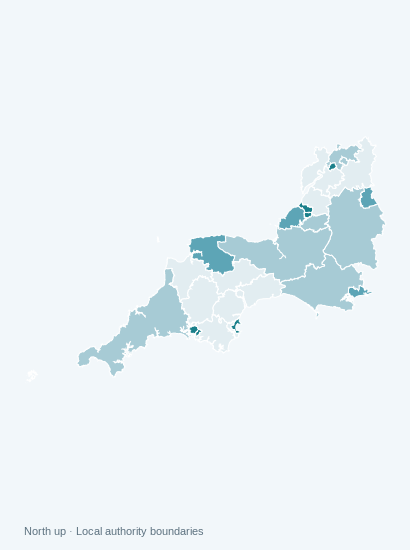
Compare all 27 council areas: exact counts and education deprivation
| Council area | All LSOAs | Overall IMD decile 1 | Education domain decile 1 |
|---|---|---|---|
| Plymouth | 164 | 19 (11.6%) | 25 (15.2%) |
| Bristol, City of | 268 | 30 (11.2%) | 44 (16.4%) |
| Gloucester | 82 | 9 (11.0%) | 18 (22.0%) |
| Torbay | 91 | 10 (11.0%) | 9 (9.9%) |
| Swindon | 140 | 10 (7.1%) | 16 (11.4%) |
| North Somerset | 138 | 9 (6.5%) | 8 (5.8%) |
| North Devon | 59 | 3 (5.1%) | 6 (10.2%) |
| Bournemouth, Christchurch and Poole | 240 | 12 (5.0%) | 8 (3.3%) |
| Cornwall | 336 | 11 (3.3%) | 19 (5.7%) |
| Cheltenham | 77 | 2 (2.6%) | 4 (5.2%) |
| Bath and North East Somerset | 118 | 3 (2.5%) | 5 (4.2%) |
| Dorset | 223 | 5 (2.2%) | 6 (2.7%) |
| Somerset | 339 | 7 (2.1%) | 24 (7.1%) |
| Tewkesbury | 56 | 1 (1.8%) | 1 (1.8%) |
| Wiltshire | 307 | 2 (0.7%) | 7 (2.3%) |
| Cotswold | 56 | 0 (0.0%) | 0 (0.0%) |
| East Devon | 88 | 0 (0.0%) | 1 (1.1%) |
| Exeter | 78 | 0 (0.0%) | 3 (3.8%) |
| Forest of Dean | 50 | 0 (0.0%) | 0 (0.0%) |
| Isles of Scilly | 1 | 0 (0.0%) | 0 (0.0%) |
| Mid Devon | 44 | 0 (0.0%) | 2 (4.5%) |
| South Gloucestershire | 175 | 0 (0.0%) | 1 (0.6%) |
| South Hams | 49 | 0 (0.0%) | 0 (0.0%) |
| Stroud | 72 | 0 (0.0%) | 2 (2.8%) |
| Teignbridge | 86 | 0 (0.0%) | 1 (1.2%) |
| Torridge | 38 | 0 (0.0%) | 2 (5.3%) |
| West Devon | 32 | 0 (0.0%) | 0 (0.0%) |
Each measure uses its own national ranking. These are neighbourhood shares, not population poverty rates or assessments of individual learners. A zero does not mean an absence of disadvantage.
TA calculations from corrected MHCLG IoD2025 File 7 and ONS 2024 authority geography. 3,407 neighbourhoods (2021 LSOAs) in this region. Contains OS data and National Statistics data © Crown copyright and database right 2026.
West of England and North Somerset: distinguish the growth market from the funding boundary
Advanced manufacturing, clean energy, screen and digital activity offer strong specialist opportunities alongside care, childcare and logistics. The LSIP identifies technicians, maintenance and design capability, practical factory experience and the difficulty of recruiting technical tutors. A credible offer therefore needs both employer access and an affordable teaching workforce.
The 2026 UPN-00266 Bootcamp competition used Atamis, twelve sector lots and an estimated £13.7 million excluding VAT across its advertised contract period and extensions. Its July tender window has closed. Treat the notice as evidence of buyer priorities and partnership possibilities, not an available annual budget. North Somerset’s council still describes full combined-authority membership as expected in late 2026 or early 2027; check the effective change before applying devolved residency rules.
On 13th October 2026, the authority announced £11.5 million for technical training over three years. This includes £9.7 million for facilities at Bath College, City of Bristol College, SGS College and St Brendan’s College, plus £1.5 million for teacher industry exchange and student placements. City of Bristol College also received a £248,000 award for 48 adult-skills places. These are announced investments, not an open provider competition. The package mixes purposes and periods, so it is not added to the annual allocation subtotal. Providers should test partnership opportunities with the named colleges.
On 23rd October 2026, WECA endorsed the strategic direction and outcomes-led approach of its Adult Skills Strategic Commissioning Plan for 2027/28 to 2035/36. The decision, published on 27th October, also delegates administration of delivery plans, budgets and provider arrangements until 22nd October 2029, with annual reporting on funding use and outcomes. Providers should connect a multi-year growth plan with measurable learner outcomes and evidence of value for money. Funding amounts remain tied to their separately published periods.
Gloucestershire, Swindon and Wiltshire: technical capability with a practical entry route
Gloucestershire’s cyber and secure-technology strengths sit alongside engineering, agri-tech, energy and creative activity. The LSIP calls for practical digital confidence as well as advanced specialists. An entry-level digital course and a security-focused technical pathway need different employer commitments, prerequisites and progression measures.
Swindon and Wiltshire adds a pronounced defence and life-sciences dimension: systems engineering, laboratory and quality roles, automation and cyber resilience. Experienced workers and service leavers are valuable audiences when prior skills are assessed properly. Work Wiltshire is already inviting provider expressions of interest for Wave 8 from April 2027. This is a useful engagement route, with procurement details still to be established.
Somerset, Dorset and BCP: combine industrial demand with the everyday workforce
Somerset’s current plan links nuclear and low-carbon energy, high-value manufacturing and construction with agri-food, visitor services and care. Employers need trades and maintenance skills as well as project management, quality assurance and digital production. The useful question is which part of an industrial supply chain a provider can serve now, with verified local recruitment and facilities.
Dorset’s priorities include advanced manufacturing and marine, construction, digital and creative work, professional services, care and clean energy. Its plan identifies maintenance engineers, quality inspectors, retrofit capability and specialist care skills. The shared Dorset and Somerset Wave 7 directory already lists approved delivery, including heat pumps, industrial coatings, transport, digital productivity and early years. Use that evidence to identify complementary provision and delivery partners.
Greater Devon: new adult skills commissioning, wider programme geography
Devon and Torbay took responsibility for ASF and FCfJ from academic year 2026/27. Published grant recipients include Learn Devon, Exeter and North Devon Colleges Group, South Devon College, Bicton, City College Plymouth, On Course South West and WEA. An organisation based in Plymouth can receive funding for eligible Devon and Torbay residents without Plymouth itself becoming part of the devolved area.
Devon County Council’s Skills Framework is also relevant to contracted delivery. An October ASF/FCfJ further-competition notice identifies DCC as procuring for the combined authority. Check the framework’s admission and call-off arrangements directly; the authority’s general webpage and procurement notices are not synchronised. For learner referrals, Connect to Work (CtW) is already operating across Devon, Plymouth and Torbay, led by DCC with the two unitary councils.
Cornwall and the Isles of Scilly: specialist opportunity needs a local recruitment engine
A bespoke course still needs a route into the supplier pool. In its reply to TA on 29th June 2026, Cornwall Council confirmed that Wave 7 had been commissioned through its DPS and only existing members could bid. The public procurement identifies this as the Adult Skills and Skills Bootcamps DPS, DN753886, with Bootcamps under Lot 3 through ProContract/Due North. The council said new-provider admission was closed at that point and offered to record interest for a future reopening.
Cornwall described bespoke Bootcamps as an employer recruitment-led process: an employer identifies a need, and the council normally brokers a course with an existing DPS provider. It is not a separate entry route for an unapproved supplier. Make your specialist capability and employer demand visible while establishing when you can join the pool. The June correspondence did not confirm a reopening date or a Wave 8 allocation.
Prepare for the next commissioning round. Cornwall’s November 2026 market research asks providers to return proposed 2027/28 provision by close of business on 25th November. The council expects funding allocations in December and anticipates competitive commissioning in January 2027, subject to confirmation. Use employer demand, delivery readiness and LSIP alignment to shape your response. Follow the Wave 8 opportunity for the distinction between this research stage and a later tender.
Cornwall College’s 2026/27 statement identifies technical priorities including critical minerals, marine, renewables, construction and agri-food. A new entrant should demonstrate what it adds to existing pathways: employer access, specialist equipment or reach into underserved communities. Cornwall and Isles of Scilly CtW operates through the People Hub, providing a separate employment-support connection.
Keep the commissioner and local delivery partner in view
The directory separates upper-tier and unitary responsibilities from district-level partnerships. Local councils may contribute venues, housing or regeneration links, employer networks and referrals without holding the devolved ASF allocation. Confirm who signs the agreement, which residents are eligible and which body manages performance before treating a relationship as a route to funded delivery.
On 29th October 2026, government withdrew the July decision for Devon, Plymouth and Torbay. Gloucestershire now has provisional support for one council, subject to representations, final decisions and Parliamentary approval. Keep current programme commissioners in the buyer map while the process continues. The further representation period for Gloucestershire runs from 23rd November to 14th December 2026. Final decisions remain outstanding.
Buyer and delivery geography
Find the lead. Build the local delivery relationships.
Choose a shaded area or a commissioning geography below to see the programme lead and local council network.
Select a numbered area
Selected geography
West of England and North Somerset
- Programme lead
- WECA: devolved ASF and Bootcamps. North Somerset accession remains pending.
- Delivery and access
- Bristol, Bath and North East Somerset and South Gloucestershire are current WECA constituents. North Somerset accession remains pending; its present resident eligibility must be checked separately.
- Local council network
- Bath and North East Somerset · Bristol, City of · North Somerset · South Gloucestershire
Complete directory: 27 council areas
| Council area | Upper-tier area | Commissioning geography |
|---|---|---|
| Bath and North East Somerset | Bath and North East Somerset | West of England and North Somerset |
| Bournemouth, Christchurch and Poole | Bournemouth, Christchurch and Poole | Somerset and Dorset |
| Bristol, City of | Bristol, City of | West of England and North Somerset |
| Cheltenham | Gloucestershire | Gloucestershire |
| Cornwall | Cornwall | Cornwall and the Isles of Scilly |
| Cotswold | Gloucestershire | Gloucestershire |
| Dorset | Dorset | Somerset and Dorset |
| East Devon | Devon | Greater Devon |
| Exeter | Devon | Greater Devon |
| Forest of Dean | Gloucestershire | Gloucestershire |
| Gloucester | Gloucestershire | Gloucestershire |
| Isles of Scilly | Isles of Scilly | Cornwall and the Isles of Scilly |
| Mid Devon | Devon | Greater Devon |
| North Devon | Devon | Greater Devon |
| North Somerset | North Somerset | West of England and North Somerset |
| Plymouth | Plymouth | Greater Devon |
| Somerset | Somerset | Somerset and Dorset |
| South Gloucestershire | South Gloucestershire | West of England and North Somerset |
| South Hams | Devon | Greater Devon |
| Stroud | Gloucestershire | Gloucestershire |
| Swindon | Swindon | Swindon and Wiltshire |
| Teignbridge | Devon | Greater Devon |
| Tewkesbury | Gloucestershire | Gloucestershire |
| Torbay | Torbay | Greater Devon |
| Torridge | Devon | Greater Devon |
| West Devon | Devon | Greater Devon |
| Wiltshire | Wiltshire | Swindon and Wiltshire |
District and borough boundaries follow ONS December 2024 geography. Programme leads are described separately from councils that help recruit, support and connect learners. Contains OS and National Statistics data © Crown copyright and database right 2026.
Map provision before describing a gap
Published allocations reveal established delivery relationships; approved-course lists reveal subject coverage. Neither provides a league table of provider quality. Compare those incumbents against your proposed occupation, location, timetable, learner support and employer network. The strongest entry proposition often fills a specific delivery constraint or joins an existing pathway.
College groups also cross boundaries. Weston and Gloucestershire colleges appear in West of England allocations; Plymouth organisations appear in Devon and Torbay’s grant list. Competition is therefore wider than providers headquartered inside the buyer’s area.
West of England: published adult skills allocations, 2026/27
| Provider | Published allocation / evidence |
|---|---|
| City of Bristol College | £6,571,908 plus a separately listed £248,421 Level 2 construction allocation |
| South Gloucestershire and Stroud College | £2,480,994 |
| Bath College | £1,320,201 |
| Bristol City Council | £1,474,623 |
| Weston College | £1,083,286 |
| Gloucestershire College | £688,198 |
| The Restore Trust; WEA; Women’s Work Lab | Named recipients in the current allocation schedule |
Selected published allocations, rather than total turnover or a measure of delivery quality.
Devon and Torbay: published ASF and FCfJ grants, 2026/27
| Provider | Published combined grant |
|---|---|
| Learn Devon | £4,089,154 |
| Exeter and North Devon Colleges Group | £2,856,437 |
| South Devon College | £2,125,846 |
| Cornwall College Group, Bicton | £647,070 |
| City College Plymouth | £459,759 |
| WEA | £275,254 |
| On Course South West | £91,171 |
Published grant recipients. The website lists procured contracts separately; these figures are not provider-wide funding totals.
Dorset and Somerset: approved Wave 7 projects
| Provider | Directory evidence |
|---|---|
| Bournemouth and Poole College | AI, green electrical skills and heat pumps |
| Train Talent; Train4All | Mechanical/HVAC and construction or engineering projects |
| Ellisons Commercial Training | Construction and passenger transport |
| Project Cosmic | AI productivity and Power Platform |
| Shoots Training | Early years |
Approved-project directory evidence, not a statement of contract value or remaining places.
Other specialist provision to understand
| Provider | Current published evidence |
|---|---|
| Cornwall College Group | 2026/27 accountability statement records welding, construction trades, ecology and critical-minerals development |
| Wiltshire College and University Centre | Current Bootcamp offer includes management, heating engineering, groundworks and education |
Provider publications establish curriculum presence; no unverified 2026/27 award amount is attributed.
Five decisions to make before investing
Build a short evidence pack for one local market, then test it with the relevant commissioning team and employers.
- Choose the resident geography and programme before selecting the qualification or delivery postcode.
- Use an LSIP occupation or progression gap to secure named employer involvement, interviews, placements or workforce release.
- Check the current portal, framework admission and call-off stage. Ask Wiltshire about Wave 8 engagement now.
- Compare your offer with funded incumbents and approved Bootcamps, then identify a specific partnership or provision gap.
- Cost recruitment, travel, specialist tutors, equipment and learner support against realistic cohort sizes.
The commercial opportunity is where three maps overlap
The South West offers substantial scope for providers with a clear specialism, but its scale makes an undifferentiated regional expansion expensive. Overlay the funding map, the occupational map and the learner-access map. Where all three align, there is a credible case for investment; where one is missing, resolve it before promising delivery.
Sources and scope
Evidence checked on 21st October 2026 using national grant determinations, current council programme pages, published provider allocations and the current LSIP cycle. Cornwall’s published LSIP was confirmed, but its hosted full text was not retrievable; the Cornwall sector summary therefore uses the college’s 2026/27 accountability statement and council strategy pages. Procurement routes are dated evidence, not a list of open tenders. Amounts retain their published financial or academic year; national ASF allocations in non-devolved areas and all employer-funded training are outside the funding table. The 21st October update also incorporates dated TA correspondence and buyer-issued procurement material where identified in the article; individual contacts and client identities are omitted. Targeted update on 23rd October 2026: the 13th October West of England investment announcement was added. Its multi-year package is kept separate from the annual allocation table; this is not a new full fact file review.
Continue the thinking
England’s skills sectors
Compare the national picture across all 15 subject areas.
What makes local delivery credible?
Turn your chosen geography into a convincing delivery case.
Shape the opportunity before the tender
Use buyer engagement to test and strengthen your proposition.