
The North West is a substantial education and skills market, but it is not one market. Greater Manchester and Liverpool City Region have integrated settlements. Lancashire has just taken on devolved ASFing. Cheshire and Warrington, and Cumbria, are developing new combined-authority arrangements while existing councils and agencies continue to commission provision.
This fact file covers England’s statistical North West: Greater Manchester, Liverpool City Region, Lancashire, Cheshire and Warrington, and Cumbria. Together they contain 35 lower-tier or unitary local authority areas and five Local Skills Improvement Plans. Lancashire County Council is an additional upper-tier authority, not a 36th district on the map.
The commercial question is where demand, delivery capability and access coincide. A sector can be a regional priority while its current contracts are already allocated. A smaller council commission can offer a more immediate route than a large headline settlement. Start with the place, the occupational problem and the buyer’s next usable route.
In this article
One region, five skills markets
The five areas are a useful starting point because they connect the LSIPs with distinct commissioning systems. They also prevent geographical mistakes: Halton sits within Liverpool City Region for this purpose, while Warrington sits with Cheshire. Blackburn with Darwen and Blackpool are part of the Lancashire skills geography alongside the county council’s twelve districts.
Greater Manchester Combined Authority (GMCA), and Liverpool City Region Combined Authority (LCRCA), hold devolved adult skills budgets within wider integrated settlements. Lancashire Combined County Authority (LCCA), took responsibility for devolved Adult Skills Fund (ASF) from August 2026. Its adult skills grant and Skills Bootcamps funding remain separately identifiable.
Cheshire and Warrington Combined Authority was established on 24th February 2026. Cumbria Combined Authority was established in March 2026. Neither should be treated as the current holder of a devolved ASF allocation on the same basis as GMCA or LCRCA. Cheshire and Warrington is preparing for adult skills devolution in 2027; Cumbria’s published planning material identifies an intended August 2027 start.
For each programme, check learner residence, employer requirements and delivery geography. The location of a provider’s head office does not determine where it holds contracts or whom it can train. The regional authority, the accountable council and the body running the procurement may also be different organisations.
Five markets / five routes
Choose the commissioning system before committing capacity.
10 boroughs
Greater Manchester
01 / Route to understandEstablished delivery now. New commissioning model being prepared for 2027/28.
6 boroughs
Liverpool City Region
02 / Route to understandASF selection has passed initial entry. Bootcamp DPS supplier admission remains a separate route.
14 district / unitary areas
Lancashire
03 / Route to understandNewly devolved ASF. Established framework membership governs access to relevant call-offs.
3 unitary councils
Cheshire and Warrington
04 / Route to understandProgramme-page grant proposals. Adult skills devolution being prepared for 2027.
2 unitary councils
Cumbria
05 / Route to understandCumberland leads Bootcamps; Westmorland and Furness hosts county-wide Adult Learning.
Financial year 2026/27, rounded. GM and LCR totals combine four adult skills components. Lancashire ASF/FCfJ includes the engineering top-up and reflects devolution from August. Cheshire and Cumbria figures show Bootcamps only, not their whole skills markets. Exact amounts and periods appear below.
Who has the money, and how much?
Use the funding period before comparing the figures. A financial year runs from April to March; an academic year runs from August to July. An integrated settlement component, a provider allocation and a tender’s maximum value describe different things. Adding all three would count the same delivery system more than once.
Greater Manchester’s four adult skills settlement components total £108,629,065 for financial year 2026/27. Liverpool City Region’s equivalent components total £63,751,426. Both are TA calculations from ASF including Free Courses for Jobs (FCfJ), the ASF construction uplift, Skills Bootcamps and the Bootcamps construction package.
Lancashire’s published ASF core allocation is £27,282,065 for financial year 2026/27 and £41,159,515 for academic year 2026/27. Adding its separate FCfJ base and engineering top-up gives adult skills totals of £29,859,369 and £45,110,504 respectively. The financial-year figure reflects the first year of devolution, which began in August; it should not be mistaken for a full academic-year delivery budget.
Lancashire also has £3.2m of Skills Bootcamps funding for financial year 2026/27. Cheshire and Warrington has £2m and Cumberland, for the Cumbria programme, has £1.5m. The construction amounts within those three allocations are included in the totals, unlike the separately listed construction components in the GMCA and LCRCA settlement tables.
These figures show scale, not an uncommitted balance available to new providers. Current agreements, grants, extensions and call-offs already draw on them. Employment support, capital investment and apprenticeships need their own analysis rather than being folded into a single supposed training pot.
Adult skills allocations: financial year 2026/27
Exact government allocation lines, with calculated subtotals identified. No procurement values are added.
Greater Manchester: calculated subtotalFinancial year 2026/27 · Four adult skills lines above.£108,629,065
| Area / component | Amount | Interpretation |
|---|---|---|
| ASF including FCfJ | £102,539,086 | Integrated settlement component. |
| ASF construction | £1,442,127 | Separate uplift. |
| Bootcamps | £3,543,322 | Base component. |
| Bootcamps construction | £1,104,530 | Separate component. |
| calculated subtotal | £108,629,065 | Four adult skills lines above. |
Liverpool City Region: calculated subtotalFinancial year 2026/27 · Four adult skills lines above.£63,751,426
| Area / component | Amount | Interpretation |
|---|---|---|
| ASF including FCfJ | £56,783,451 | Integrated settlement component. |
| ASF construction | £798,612 | Separate uplift. |
| Bootcamps | £4,703,260 | Base component. |
| Bootcamps construction | £1,466,103 | Separate component. |
| calculated subtotal | £63,751,426 | Four adult skills lines above. |
Lancashire: calculated adult skills subtotalFinancial year 2026/27 · ASF and FCfJ, including engineering; excludes Bootcamps.£29,859,369
| Area / component | Amount | Interpretation |
|---|---|---|
| ASF core | £27,282,065 | First financial year of devolved ASF. |
| FCfJ base | £2,265,743 | Separate from ASF core. |
| FCfJ engineering top-up | £311,561 | Separate additional package. |
| calculated adult skills subtotal | £29,859,369 | ASF and FCfJ, including engineering; excludes Bootcamps. |
Lancashire Skills Bootcamps: Skills BootcampsFinancial year 2026/27 · Includes £800,000 for construction.£3,200,000
| Area / component | Amount | Interpretation |
|---|---|---|
| Skills Bootcamps | £3,200,000 | Includes £800,000 for construction. |
Cheshire and Warrington: Skills BootcampsFinancial year 2026/27 · Includes £500,000 for construction.£2,000,000
| Area / component | Amount | Interpretation |
|---|---|---|
| Skills Bootcamps | £2,000,000 | Includes £500,000 for construction. |
Cumberland / Cumbria: Skills BootcampsFinancial year 2026/27 · Includes £400,000 for construction.£1,500,000
| Area / component | Amount | Interpretation |
|---|---|---|
| Skills Bootcamps | £1,500,000 | Includes £400,000 for construction. |
Sources: integrated settlement tables and DWP 2026/27 adult skills and Skills Bootcamps allocation letters. FCfJ means FCfJ. Settlement components can sit within flexible local programmes. Lancashire academic-year figures are stated separately in the text.
What skills does each local economy need?
All five areas have current LSIPs for 2026 to 2029. Their value is in the detail beneath a priority-sector label: the occupation, level, practical experience and business problem that employers describe. They should shape the offer and the questions you ask in engagement, rather than serve as a generic justification for an existing course catalogue.
The plans reveal different kinds of shortage. Greater Manchester reports demand for experienced Class 1 HGV drivers despite strong entry-level interest. Lancashire describes recruitment freezes and a preference for experienced hires. Cumbria faces low applicant numbers as well as shortages of entry-level workers, skilled trades and higher-level technical staff.
Cheshire and Warrington places weight on conversion, retention and progression, including the gap between Level 3 and higher-level technical roles. Its life sciences evidence also points to available laboratory provision that employers are not fully using. Liverpool City Region emphasises progression of existing workers, compliance and applied digital capability across sectors.
A shortage of experienced staff is not automatically a market for more introductory courses. Establish whether the useful intervention is recruitment preparation, practical experience, licence acquisition, specialist technical depth, supervision or progression for people already in work. The right intervention can be shorter and more specific than a full qualification.
The graphic below translates recurring needs into curriculum questions and relevant Sector Subject Areas, or SSAs. The mapping is TA analysis using Ofqual’s classifications. Qualification-level classification, approved learning aims and local funding rules still determine what can be funded.
The five current LSIPs
Read the local need beneath the sector heading.
Greater Manchester
Employer representative body: Greater Manchester Chamber of Commerce
Local priorities: Construction · Logistics · Health and social care · Engineering and manufacturing · Digital and technology · Creative and media · Hospitality · Financial, business and professional services
Separate entry demand from experienced-worker shortages. Build applied experience and progression around the occupation.
Explore occupations, levels and employer clusters
| Priority | Evidence and delivery implications |
|---|---|
| SSA 5: Construction, Planning and the Built EnvironmentConstruction | Mechanical/electrical engineers at Levels 4 to 6; Level 3 electricians; bricklayers, quantity surveyors and roofers. BIM demand is emerging, with relevant provision at Levels 3 to 4. |
| SSA 4: Engineering and Manufacturing TechnologiesSSA 7: Retail and Commercial EnterpriseLogistics | Class 1 HGV drivers with 3 to 5 years of experience, plus business development and customer service skills. Entry-level interest is strong, but early mentoring and retention are weak. |
| SSA 1: Health, Public Services and CareHealth and social care | Healthcare assistants and nurses; senior care worker progression at Levels 3 to 4 and care managers at Level 5. Low uptake and limited reward for additional responsibility hinder progression. |
| SSA 4: Engineering and Manufacturing TechnologiesEngineering and manufacturing | Level 6 engineering, especially mechanical/electrical; Level 3 electrical/electronic technicians, PCB repair, welders, metal fabricators and multiskilled electromechanical technicians. Automation and advanced manufacturing trade skills are emerging. |
| SSA 6: Digital TechnologyDigital and technology | Cybersecurity; data engineering, analytics and literacy; cloud computing; software engineering; IT technicians, with mid-level/senior staff expected to hold Level 3+ qualifications. AI/ML engineering is an emerging priority. |
| SSA 9: Arts, Media and PublishingCreative and media | Responsible AI use, live-performance technical skills, digital marketing, AR/VR. Live-performance workforce coordination matters where screen-sector demand fluctuates. |
| SSA 7: Retail and Commercial EnterpriseHospitality | Chefs, particularly mid-level commis/chef de partie recruitment, and retention/progression of junior staff. Supervisory hotel routes at Level 3 and leisure qualifications at Levels 2 to 4 already exist but have uptake problems. |
| SSA 15: Business, Administration and LawFinancial, business and professional services | Qualified experienced solicitors; B2B sales/business development; experienced accounting/finance staff, including AAT/ACCA/ICAEW routes at Levels 4 to 7. Qualifications alone do not solve experience gaps. |
Clusters and anchors named in the plan: Atom Valley and Advanced Machinery and Productivity Institute (advanced manufacturing and materials); Oxford Road Corridor, Sister and Crescent Salford (science, innovation, digital and professional services growth locations); MediaCity, Factory International and the Sharp Project (creative infrastructure). Use these to investigate employer relationships and actual recruitment plans.
Liverpool City Region
Employer representative body: Liverpool Chamber of Commerce
Local priorities: Professional and Business Services and Financial Services · Advanced Manufacturing and Clean Energy · Construction and the Built Environment · Health, Life Sciences and Care · Visitor Economy · Creative Industries
Progress existing workers into technical and supervisory roles. Embed digital capability and compliance in the job.
Explore occupations, levels and employer clusters
| Priority | Evidence and delivery implications |
|---|---|
| SSA 15: Business, Administration and LawProfessional and Business Services and Financial Services | Levels 3 to 5 supervisory and middle-management progression; applied payroll, employment regulation and governance; literacy, communication and problem solving often at entry/Level 1 to 2; practical Word/Excel and critical data use. |
| SSA 4: Engineering and Manufacturing TechnologiesSSA 5: Construction, Planning and the Built EnvironmentAdvanced Manufacturing and Clean Energy | Progression from operative to technician, maintenance engineering and supervision across Levels 2 to 6; integrated mechanical, electrical and digital capability; robotics programming/operation/troubleshooting, automation, environmental compliance and quality systems. |
| SSA 5: Construction, Planning and the Built EnvironmentConstruction and the Built Environment | Bricklaying, electrical installation and building services; supervision and coordination, with progression at Levels 2 to 6; site readiness, literacy/communication at entry/Level 1 to 2; traditional-building retrofit, solar PV/EV installation and digital site tools. |
| SSA 1: Health, Public Services and CareSSA 2: Science and MathematicsHealth, Life Sciences and Care | Care-worker to senior/registered-manager pathways, digital care recording; laboratory technicians, biomanufacturing, clinical-trial support, regulated production, scientific/data/AI combinations and commercialisation skills. |
| SSA 7: Retail and Commercial EnterpriseSSA 8: Leisure, Travel and TourismVisitor Economy | Reliability, communication and customer service; first-line leadership; booking/POS/CRM systems and AI; food safety/allergens; ground handling, security and operations skills around Liverpool John Lennon Airport. |
| SSA 9: Arts, Media and PublishingCreative Industries | Fusion of creative, technical and commercial skills: AI-assisted production, immersive/virtual production, project/budget/client management, freelance and portfolio readiness; mid-career progression. |
Clusters and anchors named in the plan: Sci-Tech Daresbury (digital, data and high-technology cluster); Glass Futures (industrial decarbonisation and manufacturing); iiCON and The Pandemic Institute (infection and health/life-science innovation); Liverpool John Lennon Airport (visitor economy includes aviation ground operations); Baltic Triangle (creative and digital production cluster). Use these to investigate employer relationships and actual recruitment plans.
Lancashire
Employer representative body: North and Western Lancashire Chamber of Commerce
Local priorities: Advanced Manufacturing & Engineering · Construction · Hospitality, Leisure & Tourism · Social Care · Digital · National Security & Resilience · Clean Energy & Nuclear
Test whether employers will recruit new entrants. Experience, retention and targeted upskilling can matter more than cohort volume.
Explore occupations, levels and employer clusters
| Priority | Evidence and delivery implications |
|---|---|
| SSA 4: Engineering and Manufacturing TechnologiesAdvanced Manufacturing & Engineering | Engineers Levels 3 to 6; CNC machinists/production operatives and fabricators/welders Levels 3 to 4; electrical engineers listed at Level 3; data analysis Levels 3 to 6 and management Levels 4 to 6. AI, robotics, composites and smart-factory skills. |
| SSA 5: Construction, Planning and the Built EnvironmentConstruction | Bricklaying, plumbing, carpentry/joinery and roofing Levels 2 to 3; electrical Level 3; management Levels 3 to 6. Core problem is experienced staff and whether training converts to durable employment. |
| SSA 7: Retail and Commercial EnterpriseSSA 8: Leisure, Travel and TourismHospitality, Leisure & Tourism | Chefs Levels 2 to 4, front of house Level 2, management Levels 3 to 4, general hospitality/leisure Level 2. Chef recruitment and retention dominate; essential digital and AI also matter. |
| SSA 1: Health, Public Services and CareSocial Care | Care workers and managers; care certificate standards, targeted short continuing-development training and management progression. Significant vacancy/turnover pressures alongside need to attract new entrants. |
| SSA 6: Digital TechnologyDigital | Essential digital/office software plus cyber, web development, coding and digital marketing. AI training must meet firms at different adoption stages, including safe/ethical use and evaluating outputs. |
| SSA 3: Agriculture, Horticulture and Animal CareSSA 4: Engineering and Manufacturing TechnologiesSSA 6: Digital TechnologyNational Security & Resilience | Defence/cyber needs largely sit within manufacturing and digital priorities; further employer research is required to isolate additional needs. Food security includes agriculture, food production/manufacturing. |
| SSA 4: Engineering and Manufacturing TechnologiesSSA 5: Construction, Planning and the Built EnvironmentClean Energy & Nuclear | Monitor project-specific requirements, nuclear lifecycle changes and offshore-wind demand. Plan itself records uncertainty around future reactor/site decisions and calls for deeper research. |
Clusters and anchors named in the plan: BAE Systems at Warton and Samlesbury (aerospace and defence cluster); National Cyber Force, Samlesbury (strategic cyber anchor); Springfields/Westinghouse, National Nuclear Laboratory (Preston), Heysham (nuclear capability cluster named in plan); Blackpool, Morecambe and Fylde (visitor-economy geography). Use these to investigate employer relationships and actual recruitment plans.
Cumbria
Employer representative body: Cumbria Chamber of Commerce
Local priorities: Construction · Energy/low carbon · Land-based · Manufacturing & engineering (including defence) · Health & social care · Visitor economy (including cultural & creative)
Build workforce supply and technical capacity together. Viable local cohorts and rural access are central to delivery.
Explore occupations, levels and employer clusters
| Priority | Evidence and delivery implications |
|---|---|
| SSA 5: Construction, Planning and the Built EnvironmentConstruction | Roofing, electrical, groundworking, fenestration and civil engineering technicians; Level 2 entry/upskilling and progression to apprenticeships; intensive upskilling including older buildings. |
| SSA 4: Engineering and Manufacturing TechnologiesSSA 5: Construction, Planning and the Built EnvironmentEnergy/low carbon | Plumbing/heating, electricians, engineering technicians; systems engineering, higher-level nuclear pathways and modular short-course upskilling. Embed heat pumps in plumbing, solar PV in electrical, and net-zero practice in project management. |
| SSA 3: Agriculture, Horticulture and Animal CareLand-based | Level 2 to 6 apprenticeship pathways and adult entry routes; higher-level provision, financial planning/commercial data, digital/new technology alongside driving and animal care. |
| SSA 4: Engineering and Manufacturing TechnologiesManufacturing & engineering (including defence) | Welders, machinists and electrical apprenticeships; Level 2 production operatives; mechanical/electrical HE; aggregation of Level 4+ demand and trainer capacity; AI-enabled quality and robotics maintenance. |
| SSA 1: Health, Public Services and CareHealth & social care | Level 2 care/support workers, care certificate coverage, digital skills; care management Level 5+, nurses Level 6 and social work Levels 6 to 7; countywide access. |
| SSA 7: Retail and Commercial EnterpriseSSA 8: Leisure, Travel and TourismSSA 9: Arts, Media and PublishingVisitor economy (including cultural & creative) | Commis and chef de partie apprenticeships, hospitality team members/cooks, customer service, supervisory/people skills and management progression; flexible short courses. |
| Headline workforce need | Level 2 to 3 trades/technical roles in construction, engineering and care; entry-level workforce shortages across sectors; Level 4+ engineering, energy and digital. Low applicant numbers, ageing workforce and employability gaps. |
Clusters and anchors named in the plan: BAE Systems and Sellafield supply chains (defence and energy-security anchors); St Cuthbert’s Garden Village, Carlisle, and Marina Village, Barrow (housing-development context); Ports of Barrow and Workington (employment and infrastructure locations). Use these to investigate employer relationships and actual recruitment plans.
Cheshire and Warrington
Employer representative body: South and North Cheshire Chamber of Commerce
Local priorities: Advanced Manufacturing · Agri-tech and Food Security · Business and Professional Services · Clean Energy · Life Sciences · Construction and the Built Environment (foundational) · Health and Social Care (foundational)
Target the missing technical middle. Improve conversion and retention, and connect employers with provision already available.
Explore occupations, levels and employer clusters
| Priority | Evidence and delivery implications |
|---|---|
| SSA 4: Engineering and Manufacturing TechnologiesAdvanced Manufacturing | Level 4 to 5 technicians/engineers in automation, robotics and industrial digitalisation; Level 2 to 3 skilled-trade replacement; electrical/electrotechnical capability, control systems and low-carbon upskilling. |
| SSA 3: Agriculture, Horticulture and Animal CareSSA 4: Engineering and Manufacturing TechnologiesSSA 6: Digital TechnologySSA 7: Retail and Commercial EnterpriseAgri-tech and Food Security | Preserve specialist capability rather than assume large workforce expansion: rural Level 2 to 3 engineering/fabrication, Level 4 to 5 automation/mechatronics, Level 4 to 6 farm capability, degree-level engineering design; GPS/data/robotics and dairy technology. |
| SSA 15: Business, Administration and LawBusiness and Professional Services | Progression from Level 2 to 3 administration to Level 4 to 5 data technician, compliance and digital business analyst routes; AI, data, regulatory capability; graduate retention. |
| SSA 4: Engineering and Manufacturing TechnologiesSSA 5: Construction, Planning and the Built EnvironmentClean Energy | Immediate skilled-trade/technician needs in electrical, plumbing/heating and construction; Level 4 to 5 utilities, instrumentation and control; hydrogen/nuclear systems, safety, regulation, digital/automation and operational leadership. |
| SSA 2: Science and MathematicsSSA 4: Engineering and Manufacturing TechnologiesLife Sciences | Specialist capability rather than general headcount: Level 3 to 5 laboratory routes, especially Level 4 to 5 technicians in science, QA and pharmaceutical manufacturing; scientific/data/AI combinations, compliance and employer engagement. |
| SSA 5: Construction, Planning and the Built EnvironmentConstruction and the Built Environment (foundational) | Convert training into site competence; plumbing/heating/electrical and whole-house retrofit; Level 4 to 5 supervision, retrofit coordination and QA; heritage craft capability; SME participation. |
| SSA 1: Health, Public Services and CareHealth and Social Care (foundational) | Retention and completion; Level 2 to 3 progression; Level 4 to 5 nursing-associate, supervisor/team leader and advanced-practitioner pathways; registered managers; digital competence, safeguarding and leadership. |
Clusters and anchors named in the plan: Bentley, Stellantis, Siemens, Tata Chemicals and Waters (manufacturing anchors named in lsip); Alderley Park, Medicines Discovery Catapult and Dechra (life-science cluster); HyNet, Urenco Capenhurst and Birchwood Park (clean-energy/nuclear cluster); Reaseheath Advanced Engineering and Agri-Tech Centre (land-based technology, dairy and training capability). Use these to investigate employer relationships and actual recruitment plans.
Sources: five approved LSIPs in the current 2026 to 2029 cycle. Lancashire’s plan is titled July 2026. Cheshire and Warrington’s five growth sectors include Business and Professional Services, with construction and care as foundational sectors. Implications are TA analysis.
LSIP evidence to curriculum
Design for the skill gap, then choose the subject route.
Across all five areas
Engineering, manufacturing and energy
Skilled trades, multiskilled technicians, automation, maintenance and technical progression.
4.1 Engineering · 4.2 Manufacturing technologies
Specify the machinery, practical assessment and occupational level. Test demand for new entrants separately from experienced-worker conversion.
Across all five areas
Construction and retrofit
Trade competence, electrical and building services, site readiness and supervision.
5.2 Building and construction · 4.1 Engineering
Connect training to real site experience. Build progression into quality assurance, retrofit coordination or supervision where employers need it.
Across all five areas
Health and care
Frontline recruitment, retention, senior care progression, digital records and management.
1.3 Health and social care · 1.2 Nursing, and subjects and vocations allied to medicine
Separate care-worker entry from regulated professional pathways. Show how employers will support progression and retain staff.
Cheshire and Warrington; LCR
Science and laboratory capability
Laboratory technicians, regulated production, quality systems and scientific data.
2.1 Science · 4.2 Manufacturing technologies
Test the use of existing provision before adding capacity. Secure practical laboratory access and a defined technician progression route.
Across all five areas
Digital, data and AI
Specialist cyber and data skills alongside practical digital competence in everyday jobs.
6.1 Digital technology (practitioners) · 6.2 Digital technology (users)
Separate the practitioner pathway from workplace adoption. Assess people on relevant tasks, data judgement and effective use of tools.
Cumbria, Cheshire and Warrington; Lancashire
Land-based work and agri-tech
Agriculture, food security, engineering, automation and farm business capability.
3.1 Agriculture · 3.2 Horticulture and forestry · 3.3 Animal care and veterinary science · 4.1 Engineering
Build around the actual agricultural or engineering role. Aggregate employer demand where specialist rural cohorts would otherwise be too small.
Different priority tiers across the region
Hospitality and the visitor economy
Chefs, customer service, first-line leadership, retention and practical digital systems.
7.4 Hospitality and catering · 8.2 Travel and tourism
Design for seasonal demand and shift patterns. A route from junior staff to competent chef or supervisor can address a persistent bottleneck.
Explicit GM and LCR priorities
Creative production and media
Technical production, responsible AI use, portfolios and commercial capability.
9.1 Performing arts · 9.2 Crafts, creative arts and design · 9.3 Media and communication
Use live briefs, production facilities and credible client work. Include project costing, freelance readiness and routes to paid experience.
Explicit Greater Manchester priority
Logistics and transport
Experienced HGV drivers, practical operations, customer service and retention.
4.3 Transportation operations and maintenance · 7.2 Warehousing and distribution
A driving qualification does not supply years of experience. Establish mentoring, insurance and employer onboarding requirements before promising job conversion.
GM, LCR, Cheshire and Warrington
Business and professional progression
Supervision, compliance, accounting, data-led business roles and experienced professionals.
15.1 Accounting and finance · 15.2 Administration · 15.3 Business management · 15.4 Marketing and sales · 15.5 Law and legal services
Identify the missing step between an existing role and the next responsibility. Align learning with supervised practice and the relevant professional pathway.
English, maths, digital confidence and preparation for work can connect residents to occupational pathways. SSA 14.1 Foundations for learning and life and 14.2 Preparation for work help organise that provision. Tie the foundation offer to a real next step.
TA crosswalk, not an official allocation of LSIP sectors to SSAs. The qualification’s assigned SSA and the funder’s rules determine classification and eligibility. Energy, defence and digital applications can span several subject routes.
Where participation needs a different delivery model
Across the region, 923 of 4,567 neighbourhoods fall within England’s most deprived 10% in the English Indices of Deprivation 2025. That is 20.2% of North West neighbourhoods, calculated from the underlying data. It describes the proportion of small areas in a national band, not the proportion of residents living in poverty.
At local authority level, the proportions are 40.7% in Manchester, 40.4% in Blackpool, and 40.0% in both Knowsley and Burnley. The map also shows why a single regional recruitment model would be weak: the same measure is 2.5% in Cheshire East and 0.0% in Ribble Valley, while sizeable pockets remain elsewhere.
Overall deprivation and the education, skills and training domain are different measures. In Manchester, 10.5% of neighbourhoods are in the education domain’s most deprived tenth, compared with 40.7% on the overall index. Knowsley’s education figure is 39.0%. Do not use overall deprivation as a direct proxy for a learner’s qualification level.
For a practical delivery plan, test trusted referral partners, transport, shift patterns, caring commitments, health barriers and the cost of remaining on programme. In Cumbria and rural Lancashire, also test dispersed catchments and realistic travel times. A lower authority-wide deprivation percentage does not remove the need to investigate access at neighbourhood level.
Put the support model into the cost model. Identify which recruitment, travel, learning support and retention activities the funder will pay for. A technically strong programme can still fail if learners cannot reach it, fit it around work or sustain participation.
English Indices of Deprivation 2025
Place changes the cost of reaching and retaining learners.
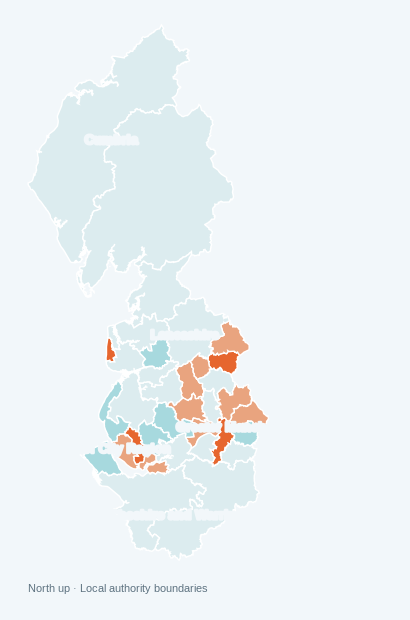
Compare all 35 authorities: exact counts and education deprivation
| Authority | All LSOAs | Overall IMD decile 1 | Education domain decile 1 |
|---|---|---|---|
| Manchester | 295 | 120 (40.7%) | 31 (10.5%) |
| Blackpool | 94 | 38 (40.4%) | 28 (29.8%) |
| Knowsley | 100 | 40 (40.0%) | 39 (39.0%) |
| Burnley | 60 | 24 (40.0%) | 17 (28.3%) |
| Blackburn with Darwen | 91 | 34 (37.4%) | 31 (34.1%) |
| Oldham | 142 | 53 (37.3%) | 40 (28.2%) |
| Liverpool | 302 | 111 (36.8%) | 78 (25.8%) |
| Pendle | 57 | 20 (35.1%) | 17 (29.8%) |
| Hyndburn | 53 | 17 (32.1%) | 10 (18.9%) |
| Halton | 80 | 25 (31.3%) | 20 (25.0%) |
| Rochdale | 135 | 42 (31.1%) | 30 (22.2%) |
| Bolton | 177 | 46 (26.0%) | 28 (15.8%) |
| Salford | 161 | 41 (25.5%) | 30 (18.6%) |
| Wirral | 209 | 49 (23.4%) | 36 (17.2%) |
| St. Helens | 121 | 28 (23.1%) | 22 (18.2%) |
| Sefton | 191 | 36 (18.8%) | 29 (15.2%) |
| Tameside | 142 | 25 (17.6%) | 10 (7.0%) |
| Preston | 87 | 15 (17.2%) | 12 (13.8%) |
| Wigan | 200 | 31 (15.5%) | 25 (12.5%) |
| Wyre | 69 | 9 (13.0%) | 7 (10.1%) |
| Lancaster | 88 | 10 (11.4%) | 8 (9.1%) |
| Bury | 120 | 13 (10.8%) | 6 (5.0%) |
| Cumberland | 177 | 18 (10.2%) | 23 (13.0%) |
| Rossendale | 43 | 4 (9.3%) | 1 (2.3%) |
| Cheshire West and Chester | 222 | 19 (8.6%) | 25 (11.3%) |
| Stockport | 191 | 15 (7.9%) | 16 (8.4%) |
| Westmorland and Furness | 142 | 9 (6.3%) | 6 (4.2%) |
| Warrington | 132 | 8 (6.1%) | 6 (4.5%) |
| West Lancashire | 73 | 4 (5.5%) | 9 (12.3%) |
| Trafford | 139 | 6 (4.3%) | 2 (1.4%) |
| Chorley | 70 | 3 (4.3%) | 2 (2.9%) |
| Fylde | 51 | 2 (3.9%) | 0 (0.0%) |
| South Ribble | 70 | 2 (2.9%) | 4 (5.7%) |
| Cheshire East | 244 | 6 (2.5%) | 17 (7.0%) |
| Ribble Valley | 39 | 0 (0.0%) | 0 (0.0%) |
Each measure uses its own national deprivation ranking. These are neighbourhood shares, not population poverty rates or individual skills assessments.
TA calculations from MHCLG IoD2025 File 7: decile 1 neighbourhoods divided by all 2021 LSOAs in each authority. Regional denominator: 4,567 LSOAs. The chart selects the twelve highest authority proportions; the directory includes all 35. ONS May 2024 boundaries, generalised and clipped. Contains OS data and National Statistics data © Crown copyright and database right 2026.
Greater Manchester: prepare for the next commissioning model
GMCA’s 2026/27 position is principally continuity of established grant and procured delivery. Its published core ASF workbook contains 32 provider or lot rows covering 29 distinct provider identifiers. The current-year decisions continue established delivery. The proposed timetable envisages procurement during 2027/28 and new arrangements from 1st August 2028, subject to further approvals.
The published decision for 13th November 2026 records agreement to GMCA’s future adult-skills policy approach and the principle of maintaining access to procured provision while future arrangements are developed. It also records approval of £3m for Level 3 growth and Construction Skills Package mobilisation. Subsequent commissioning documents will establish supplier-entry routes. The Education, Work and Skills Flexible Procurement System remains an established route; check its current admission arrangements before preparing an application.
Read the offer through Greater Manchester’s wider employment and health agenda. Its integrated settlement includes £14,435,348 under a Connect to Work (CtW) component, £4,988,000 for WorkWell and £10m for an economic inactivity trailblazer in financial year 2026/27. GM uses its flexibilities through local Working Well and Live Well arrangements; the national funding label does not establish a standalone local programme or a fresh supplier competition.
Manchester City Council also has its own worklessness procurement. The initial stage closed on 16th September 2026, with an intended contract start of 1st February 2027. The notice’s maximum estimate is £3.75m excluding VAT, with further funding conditional. This is a council-level employment route, separate from GMCA’s core ASF allocations.
Provider implication: use the coming commissioning decisions to test how occupational skills, foundation learning, health and employment support will connect. Bring employer evidence and a credible local recruitment route. A claim to cover all ten boroughs is less useful than showing which specific learners and employers you can reach.
GMCA’s Sector Development Plans help providers prepare while commissioning decisions are pending. They identify capabilities needed for frontier-sector growth and are intended to be updated at least annually. Use them to shape employer conversations and curriculum proposals, then distinguish that strategic direction from a published procurement timetable.
Sizewell C’s Manchester office, announced on 14th November 2025, shows why a project’s location does not define its whole skills market. The power station is being built in Suffolk, but the Manchester base draws on northern nuclear expertise. Its supplier network includes manufacturing in Bury and uranium enrichment at Capenhurst near Chester. Follow employers and supply chains as well as the construction site; this is a demand signal, not a new GMCA training contract.
Liverpool City Region: distinguish ASF selection from Bootcamp admission
LCRCA has two different access questions. Its ASF competition for delivery beginning in August 2027 is a selective process. Its existing Skills Bootcamps DPS offers an admission route followed by specific call-offs. Being able to apply to one does not mean the other is open to a new entrant.
The ASF procurement, reference PA000599 / DN824853, is estimated at £7.5m a year excluding VAT, or £37.5m across the maximum five-year period. The initial agreement runs from 1st August 2027 to 31st July 2028, with annual extension options through 31st July 2032. The first-stage selection deadline was 17th September 2026. Stage 2 is for suppliers invited after that selection process; use the buyer-issued timetable for the submission deadline.
For Skills Bootcamps, the current DPS is DN602074, advertised through the ProContract portal under the Merseytravel buyer alias. The portal checked on 15th November 2026 advertises continuing supplier admission across 13 categories, with the current assessment round ending at 8pm on 1st December 2026 (GMT). Applications are opened monthly. Secure the relevant categories, then compete for individual delivery contracts. The round cutoff is distinct from the DPS’s overall admission period.
The portal’s overall expression-of-interest field ends at 11am on 27th May 2027, while its narrative refers to 31st May 2027. Providers should resolve that discrepancy with the buyer and use the current submission instructions. Do not wait for the later narrative date or assume that the same arrangement will cover every future Bootcamp wave.
The council layer is material too. All six borough councils appear in the initial 2026/27 ASF grant allocations. Liverpool City Council’s separate Adult Learning Services framework has already produced community learning awards, including contracts recorded in October 2026. A provider interested in neighbourhood reach should investigate council commissioning as well as the combined authority.
Provider implication: establish your status on each route now. For invited ASF bidders, the task is a delivery proposition against the specification. For a new Bootcamp entrant, it is admission to the correct DPS categories and readiness for a call-off. For community learning, it may be a council framework or an authorised relationship with a current provider.
Lancashire: devolution changes the buyer, not every access point
Lancashire’s devolved adult skills system began in August 2026. LCCA holds the ASF responsibility, while Lancashire County Council remains important in procurement and programme delivery. Blackburn with Darwen and Blackpool are separate unitary councils within the same skills geography.
The Training Services for Adults open framework is already established. Its initial period runs from 23rd March 2026 to 22nd March 2029, within an open-framework scheme extending to 22nd March 2034. The published next reopening is planned for autumn 2029, with an earlier reopening possible. The advertised £180m including VAT is an estimate across the wider scheme, not Lancashire’s annual funding allocation.
The award record names 83 distinct appointed suppliers. Framework membership and funded work are different measures. September 2026 Wave 7 Bootcamp awards followed a mini-competition for admitted suppliers on the relevant LCCA framework lots, run by Lancashire County Council. The earlier Wave 7 approach also included extensions for existing providers alongside procurement of the remaining provision.
The October 2026 ASF and FCfJ allocation schedule shows substantial established college grants alongside smaller Skills for Life contracts. That means a new entrant should assess the actual delivery gap and the next permitted access point before committing premises or tutor capacity. The LCCA framework was procured through The Chest. Lancashire County Council’s general procurement portal is Oracle Fusion, so follow the platform named in the particular notice.
On 29th October 2026, government withdrew the July reorganisation decision for Lancashire, Blackburn with Darwen and Blackpool. All proposals remain under consideration. Keep current county, unitary and district responsibilities in the buyer map while final arrangements are decided.
Provider implication: distinguish LCCA’s funding decisions, the county council’s procurement role, and local delivery relationships in each district. A devolution announcement does not reopen a framework that has already appointed its suppliers.
Cheshire and Warrington: watch grants and the devolution transition
The three councils are Cheshire East, Cheshire West and Chester, and Warrington. The new combined authority is preparing for adult skills devolution in 2027. Current official publications describe the transition using different dates, so a provider should establish the actual responsibility and delivery period in the agreement rather than assume a single transfer date.
For Skills Bootcamps, Enterprise Cheshire and Warrington’s own programme page is a key access point. Its Wave 7 page invites proposals through a two-stage grant application process, with a form dated 3rd March 2026. The financial-year allocation is £2m including £500,000 for construction. A current closing deadline was not established, so contact the programme team to confirm the next assessment point and remaining scope before preparing a full proposal.
This is a practical example of why statutory tender alerts alone are insufficient. The public route is a programme-page grant call. Also check that the guidance attached to the current call applies to the current year: the page links to older guidance, which should not be silently treated as the definitive Wave 7 rules.
Cheshire West and Chester’s 2026/27 accountability agreement identifies an approximately £1.15m ASF baseline for its Adult Education service and a further £460,000 Pathway to Devolution pilot allocation. The council also commissions and manages Warrington’s £525,288 pilot allocation. The document says the Cheshire West commissioning was complete and Warrington commissioning was live at the time of writing; neither statement proves an open competition on the research date.
Provider implication: follow the emerging combined-authority model while working through the current accountable bodies. The strongest proposition will connect the LSIP’s technical progression and conversion needs with local employers, rather than assume that devolution creates a new generic course budget.
Local delivery was a practical requirement, not simply an engagement slogan. In the 2026/27 Cheshire West ASF pilot webinar, the buyer set a maximum £80,000 allocation per provider, asked for evidence of local need and a local delivery location, and did not plan to commission online delivery through that pilot. TA’s contemporaneous record noted the presenter’s warning that it was not a “cash cow”. The message was to offer focused provision at a scale that served residents, rather than seek the largest possible share of the budget.
The existing Adult Education DPS, DN460197, made venue availability a pass/fail entry test: applicants needed evidence of premises previously used in the area or secured use or tenancy. The saved webinar Q&A also distinguished an organisation’s office location from where learners could access provision. For an incoming provider, accessible premises, local demand and credible community relationships are more useful than a generic promise to establish a presence after award. The £80,000 cap belonged to that Cheshire West pilot; it is not a ceiling for the whole regional market.
Cumbria: know which council holds which programme
Cumbria contains Cumberland and Westmorland and Furness. The creation of Cumbria Combined Authority does not replace the immediate need to understand those councils’ programme roles. Cumberland leads the county-wide Skills Bootcamps and CtW arrangements; Westmorland and Furness hosts Cumbria Adult Learning across both council areas.
The current Bootcamp allocation is £1.5m for 1st April 2026 to 31st March 2027, including £400,000 for construction. The public programme page’s provider list remains labelled 2025/26. It is useful historic intelligence, but it should not be presented as a verified 2026/27 supplier roster.
Cumbria Adult Learning’s own 2026/27 allocation is £2,984,128, comprising £1,486,178 of core adult skills, £1,435,319 of Tailored Learning and £62,631 of FCfJ. This is the council service’s allocation, not the total funding received by all providers across Cumbria.
The service’s subcontract procurement, DN807633, has awarded five contracts for 1st August 2026 to 31st July 2027. The signed values total £588,942: Inspira, Lakes College, PHX Training, Construction Skills People and The Skills Network. The original £800,000 estimate was a procurement ceiling, not the size of Cumbria’s ASF allocation.
Recent Bootcamp awards provide more current supplier evidence than the historic roster. An engineering and manufacturing award published on 15th October 2026 names 3D360 and Lakes College against one £43,200 award value. A separate £100,000 Level 3 Construction Supervisor award names Construction Skills People. These are completed restricted call-offs, not open applications.
The LSIP creates a distinctive delivery question: how to meet both genuine recruitment shortages and higher technical requirements across a dispersed geography. Engineering and energy routes need practical equipment, competent tutors and employer access. Visitor-economy and care pathways need workable travel, timing and retention arrangements. A county-wide promise needs a credible delivery pattern behind it.
Provider implication: start by identifying the accountable council and current contract. Then test whether your contribution is a new competitive offer, a future subcontract opportunity, employer-funded delivery or a permitted specialist partnership. Do not treat an existing award or an old provider list as evidence of a live opening.
The local authorities to keep in your buyer map
The directory covers all 35 district or unitary areas. It distinguishes councils with evidenced adult learning allocations or programme responsibilities from districts whose immediate relevance is place-based employer, community and referral relationships. It is not a claim that every council currently runs a separate ASF or Bootcamp tender.
In Greater Manchester, five councils are named directly in the current core ASF grant workbook: Bury, Manchester, Oldham, Stockport and Wigan. All ten boroughs also have local skills and employment roles. In Liverpool City Region, all six councils have initial ASF grant allocations and deliver the Individual Placement and Support element of CtW.
In Lancashire, retain both levels of local government. The county council works across twelve districts; Blackburn with Darwen and Blackpool are unitary authorities. District relationships can matter for recruitment and employer engagement without making the district the holder of the devolved ASF budget.
Buyer and delivery geography
Find the lead. Build the local delivery relationships.
Choose a shaded area or a commissioning geography below to see the programme lead and local council network.
Select a numbered area
Selected geography
Greater Manchester
- Programme lead
- GMCA: devolved ASF and Bootcamps.
- Delivery and access
- Ten borough councils connect local adult learning, employment support and employer relationships to regional commissioning.
- Local council network
- Bolton · Bury · Manchester · Oldham · Rochdale · Salford · Stockport · Tameside · Trafford · Wigan
Complete directory: 35 council areas
| Council area | Upper-tier area | Commissioning geography |
|---|---|---|
| Blackburn with Darwen | Blackburn with Darwen | Lancashire |
| Blackpool | Blackpool | Lancashire |
| Bolton | Bolton | Greater Manchester |
| Burnley | Lancashire | Lancashire |
| Bury | Bury | Greater Manchester |
| Cheshire East | Cheshire East | Cheshire and Warrington |
| Cheshire West and Chester | Cheshire West and Chester | Cheshire and Warrington |
| Chorley | Lancashire | Lancashire |
| Cumberland | Cumberland | Cumbria |
| Fylde | Lancashire | Lancashire |
| Halton | Halton | Liverpool City Region |
| Hyndburn | Lancashire | Lancashire |
| Knowsley | Knowsley | Liverpool City Region |
| Lancaster | Lancashire | Lancashire |
| Liverpool | Liverpool | Liverpool City Region |
| Manchester | Manchester | Greater Manchester |
| Oldham | Oldham | Greater Manchester |
| Pendle | Lancashire | Lancashire |
| Preston | Lancashire | Lancashire |
| Ribble Valley | Lancashire | Lancashire |
| Rochdale | Rochdale | Greater Manchester |
| Rossendale | Lancashire | Lancashire |
| Salford | Salford | Greater Manchester |
| Sefton | Sefton | Liverpool City Region |
| South Ribble | Lancashire | Lancashire |
| St. Helens | St. Helens | Liverpool City Region |
| Stockport | Stockport | Greater Manchester |
| Tameside | Tameside | Greater Manchester |
| Trafford | Trafford | Greater Manchester |
| Warrington | Warrington | Cheshire and Warrington |
| West Lancashire | Lancashire | Lancashire |
| Westmorland and Furness | Westmorland and Furness | Cumbria |
| Wigan | Wigan | Greater Manchester |
| Wirral | Wirral | Liverpool City Region |
| Wyre | Lancashire | Lancashire |
District and borough boundaries follow ONS December 2024 geography. Programme leads are described separately from councils that help recruit, support and connect learners. Contains OS and National Statistics data © Crown copyright and database right 2026.
Specific local learning and employment roles
Bury
Core ASF grant holder; local adult learning, employment and referral relationships.
Manchester
Core ASF grant holder; separate Worklessness Programme procurement and local adult learning.
Oldham
Core ASF grant holder; local adult learning, employment and referral relationships.
Stockport
Core ASF grant holder; local adult learning, employment and referral relationships.
Wigan
Core ASF grant holder; local adult learning, employment and referral relationships.
Liverpool
Initial ASF grant holder; Adult Learning Services framework and community call-offs; CtW IPS delivery.
Blackburn with Darwen
Unitary council; current adult skills grant holder and CtW delivery partner.
Blackpool
Unitary council; current adult skills grant holder and CtW delivery partner.
Cheshire East
Constituent of the new combined authority; CtW delivery partner. Bootcamp proposals run through Enterprise Cheshire and Warrington.
Cheshire West and Chester
Adult Education buyer and provider; CtW accountable body; commissions its own and Warrington’s Pathway to Devolution pilots.
Warrington
CtW delivery partner; Pathway to Devolution pilot commissioned and managed by Cheshire West and Chester.
Cumberland
Cumbria Bootcamp contracting authority and CtW accountable body; constituent of Cumbria Combined Authority.
Westmorland and Furness
Hosts Cumbria Adult Learning across both unitary areas and signs its subcontract agreements; constituent of Cumbria Combined Authority.
Employment support and other routes into funded work
Employment programmes can create referral relationships, demand for specialist support and progression routes into training. They also have delivery standards and funding models of their own. A training qualification alone will not establish readiness to deliver supported employment.
Liverpool City Region’s 2026/27 settlement includes £9,579,053 for CtW. The authority’s September 2026 delivery statement identifies the six borough councils for Individual Placement and Support, and The Busy Group for the Supported Employment Quality Framework element. These are existing delivery arrangements to understand, not an open training tender.
Lancashire’s current DWP schedule records £38.8m across its CtW programme, with 11,000 planned starts. Lancashire County Council is the accountable body. The July 2026 delivery announcement names Lancashire County Council, Blackpool Council, Blackburn with Darwen Council, Ingeus, Maximus and Standguide, with delivery through March 2030.
For Cheshire and Warrington, the current DWP programme total is £16.3m with 4,150 planned starts, led by Cheshire West and Chester Council across all three councils. For Cumbria it is £11.7m with 2,800 planned starts, with Cumberland accountable across both council areas. Cumbria’s delivery contract has been awarded to Inspira. These are programme totals, not annual sums or the values of fresh competitions.
Apprenticeships, employer co-investment, adult loans where eligible, and subcontracted learning may create additional routes for a suitable provider. Assess them separately against the occupation, learner and contracting rules. Capital and major development announcements can indicate future workforce demand, but do not translate automatically into an accessible revenue contract.
Provider implication: map the organisations that control referrals as carefully as those that sign training contracts. A specialist offer can become useful through a clear handover from employment support, provided the responsibilities, outcomes and payment arrangements are agreed.
Who is already delivering, and what does that tell you?
Provider evidence is most useful when attached to a programme and year. The directories below separate current allocations, initial grant limits and named awards. They are not a league table of provider quality or market share, and they do not describe all privately funded, apprenticeship or subcontracted provision in the region.
Greater Manchester’s 2026/27 core ASF allocations include £20.91m for LTE Group and £9.60m for Manchester City Council, alongside colleges, other councils and independent providers. Mantra Learning, The Growth Company, Back 2 Work, Standguide and Construction Skills People appear in procured provision. Some organisations have more than one lot, so row counts are not provider counts.
Liverpool City Region’s initial 2026/27 grant schedule includes £10.66m for The City of Liverpool College, £5.09m for Liverpool City Council and £4.88m for St Helens College. Separate May 2026 Bootcamp awards identify Mastered Studios and Agent Academy in digital marketing, Leep Talent in data analysis, and TRS Training and LearningPlus in HGV provision.
Lancashire’s October allocation schedule includes £10.885m for East Lancashire Learning Group, £6.896m for Preston College and £6.564m for Blackpool and The Fylde College across the listed grant components. Its separate Skills for Life contracts include Back to Work Training, East Lancashire Learning Group, Inspira and PHX Training. Cumbria’s current Adult Learning subcontract awards provide a smaller, precise view of another part of the market.
Cheshire and Warrington’s current Wave 7 delivery catalogue names providers including Dulson Training, Simian Risk Management, BioGrad, 360 Nuclear Skills Training, E4All and 3D360. It shows competitive presence in specific courses, rather than award values. A complete comparable allocation list for the whole area was not established; use the programme-specific evidence below alongside council plans and future combined-authority decisions.
Test the gap against the existing offer. Can you add access to a particular employer group, practical equipment, a specialist qualification, a hard-to-reach neighbourhood or a progression step that is missing? Naming a growth sector is the start of the conversation; identifying a deliverable gap is what makes the proposition useful.
Provider evidence / explore the lists
Compare the programme, the year and the type of evidence.
Current allocations show funded incumbents. Named awards show specific contracts. Course catalogues show delivery presence. Each answers a different question about the market.
Greater Manchester core ASF · 2026/27 · 32 provider / lot rows
| Provider / lot | Route | Published allocation |
|---|---|---|
| AQUINAS COLLEGE | Grant | £101,578.00 |
| ASHTON SIXTH FORM COLLEGE | Grant | £186,266.00 |
| BOLTON COLLEGE | Grant | £6,516,351.72 |
| BURY COLLEGE | Grant | £2,708,709.84 |
| BURY METROPOLITAN BOROUGH COUNCIL | Grant | £1,492,395.48 |
| HOPWOOD HALL COLLEGE | Grant | £5,550,694.83 |
| LTE GROUP | Grant | £20,912,663.81 |
| MANCHESTER CITY COUNCIL | Grant | £9,600,342.00 |
| OLDHAM METROPOLITAN BOROUGH COUNCIL | Grant | £3,301,621.00 |
| SALFORD CITY COLLEGE | Grant | £6,572,134.18 |
| STOCKPORT METROPOLITAN BOROUGH COUNCIL | Grant | £1,557,976.00 |
| TAMESIDE COLLEGE | Grant | £4,429,792.36 |
| THE OLDHAM COLLEGE | Grant | £3,881,072.12 |
| THE TRAFFORD COLLEGE GROUP | Grant | £7,256,861.03 |
| WIGAN AND LEIGH COLLEGE | Grant | £4,760,601.19 |
| WIGAN METROPOLITAN BOROUGH COUNCIL | Grant | £1,027,361.00 |
| ACORN TRAINING - LOT 2 | Procured | £152,516.75 |
| BACK 2 WORK COMPLETE TRAINING - LOT 1 | Procured | £1,879,069.00 |
| BRIGHT DIRECTION TRAINING - LOT 1 | Procured | £1,035,450.00 |
| DMR TRAINING AND CONSULTANCY LIMITED - LOT 2 | Procured | £179,103.15 |
| GLOUCESTERSHIRE COLLEGE - LOT 1 | Procured | £808,098.00 |
| MANTRA LEARNING LIMITED - LOT 1 | Procured | £3,214,269.45 |
| MANTRA LEARNING LIMITED - LOT 2 | Procured | £1,679,626.98 |
| REALISE LEARNING & EMPLOYMENT LIMITED - LOT 1 | Procured | £956,105.97 |
| ROCHDALE TRAINING - LOT 1 | Procured | £405,863.00 |
| ROCHDALE TRAINING - LOT 2 | Procured | £155,325.98 |
| STANDGUIDE LIMITED - LOT 1 | Procured | £1,025,880.00 |
| THE CONSTRUCTION SKILLS PEOPLE LIMITED - LOT 1 | Procured | £770,812.80 |
| THE GROWTH COMPANY - LOT 1 | Procured | £3,026,613.23 |
| THE GROWTH COMPANY - LOT 2 | Procured | £364,643.47 |
| TOTAL PEOPLE LIMITED - LOT 1 | Procured | £668,860.00 |
| WORKERS' EDUCATIONAL ASSOCIATION - LOT 1 | Procured | £824,302.00 |
Source: GMCA final core ASF workbook for academic year 2026/27. The 32 rows cover 29 distinct provider identifiers. Lot 1 is unemployed provision; Lot 2 is employed provision. Amounts are allocations, not actual spending or Bootcamp awards.
Liverpool City Region ASF grants · 2026/27 · 13 providers
| Provider | Maximum initial allocation |
|---|---|
| Halton Borough Council | £734,378.79 |
| Hugh Baird College | £3,555,470.06 |
| Knowsley Metropolitan Borough Council | £1,099,175.26 |
| Liverpool City Council | £5,089,390.19 |
| Myerscough College | £971,938.14 |
| Riverside College | £2,524,069.69 |
| Sefton Metropolitan Borough Council | £1,005,298.54 |
| Southport College | £1,290,978.93 |
| St Helens College | £4,875,605.85 |
| St Helens Metropolitan Borough Council | £681,674.70 |
| The City Of Liverpool College | £10,658,663.16 |
| Wirral Metropolitan Borough Council | £1,209,462.99 |
| Wirral Metropolitan College | £4,147,624.40 |
Source: LCRCA committee Appendix 1, approved on 6th March 2026, for academic year 2026/27. These are maximum initial grant allocations, not a complete list of procured providers or final expenditure.
Lancashire adult skills allocations · 2026/27 · 17 rows
| Provider | Route / scope | Published amount |
|---|---|---|
| Blackburn College | Grant: core, Tailored Learning, FCfJ and innovation | £3,219,101.00 |
| Blackburn with Darwen Borough Council | Grant: core, Tailored Learning, FCfJ and innovation | £1,010,581.00 |
| Blackpool and The Fylde College | Grant: core, Tailored Learning, FCfJ and innovation | £6,564,157.00 |
| Blackpool Borough Council | Grant: core, Tailored Learning, FCfJ and innovation | £720,613.00 |
| Burnley College | Grant: core, Tailored Learning, FCfJ and innovation | £2,627,354.00 |
| Lancaster and Morecambe College | Grant: core, Tailored Learning, FCfJ and innovation | £1,028,309.00 |
| Myerscough College | Grant: core, Tailored Learning, FCfJ and innovation | £359,935.00 |
| East Lancashire Learning Group | Grant: core, Tailored Learning, FCfJ and innovation | £10,885,392.00 |
| NCG | Grant: core, Tailored Learning, FCfJ and innovation | £879,227.00 |
| Preston College | Grant: core, Tailored Learning, FCfJ and innovation | £6,895,831.00 |
| Runshaw College | Grant: core, Tailored Learning, FCfJ and innovation | £523,992.00 |
| Workers' Educational Association | Grant: core, Tailored Learning, FCfJ and innovation | £373,025.00 |
| Back to Work Training | Skills for Life contract | £619,249.00 |
| East Lancashire Learning Group | Skills for Life contract | £598,864.00 |
| Inspira | Skills for Life contract | £113,608.00 |
| PHX Training Limited | Skills for Life contract | £99,534.00 |
| Workers' Educational Association (Community Grants) | Community Grants | £750,000.00 |
Source: LCCA October 2026 ASF and FCfJ schedule for academic year 2026/27. Grant amounts reproduce the published total column; the separately listed Skills for Life and Community Grants rows retain their own scope. These are not framework membership counts.
Liverpool City Region Bootcamps · five named May 2026 awards
| Supplier | Programme | Award excluding VAT |
|---|---|---|
| MASTERED STUDIOS LTD | Skills Bootcamps in Digital - Digital Marketing for Business | £157,500.00 |
| AGENT ACADEMY C.I.C. | Skills Bootcamps in Digital - Digital Marketing for Business | £47,250.00 |
| LEEP TALENT LIMITED | Skills Bootcamps in Digital Data Analysis | £167,737.50 |
| TRS TRAINING LIMITED | Skills Bootcamps in HGV | £115,000.00 |
| LEARNINGPLUS LIMITED (Previously CHALLENGE-TRG SKILLS LIMITED) | Skills Bootcamps in HGV | £112,325.00 |
Source: official award notices published in June 2026, with contracts concluded on 1st May 2026. These establish named awards, not market shares or a complete current course catalogue.
Cheshire and Warrington · selected current Wave 7 delivery listings
| Provider | Listed offer |
|---|---|
| Dulson Training | HGV, forklift and passenger vehicle training |
| Simian Risk Management | Scaffolding |
| BioGrad | Laboratory skills |
| 360 Nuclear Skills Training | Nuclear project management |
| E4All | Digital accelerator and full-stack development |
| 3D360 | Advanced manufacturing, CAD and 3D printing |
| Cheshire West and Chester Council | Hospitality and forklift training |
| JCL Skills Solutions | Education, teaching assistant and SEND |
| Retro Fit Academy CIC | Retrofit assessment and coordination |
| Construction Skills People | Civil engineering and groundworks |
Source: Enterprise Cheshire and Warrington Wave 7 catalogue checked on 21st October 2026. Selected delivery listings, not a full allocation register or verified award values.
Cumbria Adult Learning · five signed 2026/27 subcontracts
| Provider | Signed contract value |
|---|---|
| Inspira | £75,048.00 |
| Lakes College | £21,368.00 |
| PHX Training | £183,983.00 |
| Construction Skills People | £50,187.00 |
| The Skills Network | £258,356.00 |
Source: Westmorland and Furness contract-details notice 076369-2026. Signed on 23rd July 2026 for 1st August 2026 to 31st July 2027. The five values total £588,942 and are part of the Adult Learning service’s delivery, not all Cumbria ASF provision.
Use engagement to shape a deliverable specification
The best time to influence the practicality of a commissioning model is before the specification is fixed. Use the LSIP, deprivation evidence and actual delivery experience to explain what a proposed model would mean for employers and learners. Make the trade-offs clear and offer a costed alternative.
In an area with experienced-worker shortages, ask whether the buyer wants new entrants, workforce progression or both. In dispersed areas, test the assumptions behind cohort size and travel. Where funding combines programmes, ask how foundation learning, technical training and employment support will be measured and paid.
- Which occupational and neighbourhood gaps remain after the current grants and contracts, and what evidence will determine the next priorities?
- Would separate lots for recruitment, experienced-worker progression and specialist technical training produce a better outcome than one broad sector lot?
- What employer commitments are required before award, and how will the model handle delayed recruitment, seasonal demand or small employer cohorts?
- Will outreach, travel, additional learning support, practical placements and retention activity be funded, and at which milestones?
- What mobilisation period is realistic for premises, equipment and specialist tutors? Can the buyer phase starts without reducing quality?
- When can new providers join the relevant framework or DPS, and which partnership or subcontract arrangements are permitted?
Turn the answers into a small number of place-specific propositions. Each should name the employer problem, learner group, delivery location, practical resources, progression route and next commissioning event. This gives both the provider and the buyer something concrete to assess.
The next decisions and access points to watch
Maintain a buyer-level watchlist covering programme pages, procurement portals, committee decisions and published provider information. Statutory notices tell part of the story; grant calls, provider admission rounds and local delivery decisions can appear elsewhere first.
North West commissioning watchlist
Baseline checked on 21st October 2026. GMCA timing and LCRCA Bootcamps admission updated on 15th November 2026. Confirm the buyer’s current instructions before acting.
| Area / route | Current position | Next useful action |
|---|---|---|
| GMCA adult skills | 2026/27 delivery allocated; November decision records agreement to the future policy approach and continuity principle. | Read the decision and follow subsequent engagement and procurement notices. |
| LCRCA ASF 2027 competition | First-stage selection closed; Stage 2 is invitation-only. | Invited suppliers: follow the buyer-issued timetable and clarification process. |
| LCRCA Bootcamps DPS DN602074 | Rolling supplier admission; current assessment round ends 8pm on 1st December 2026 (GMT). | Check the right categories, submission requirements and subsequent call-offs. |
| Lancashire Training Services for Adults open framework | Suppliers appointed; next reopening planned for autumn 2029, earlier reopening possible. | Track The Chest, reopening notices and permitted delivery partnerships. |
| Enterprise Cheshire and Warrington | Wave 7 two-stage grant proposal page available; current deadline not verified. | Confirm whether proposals are being assessed, available scope and the correct current-year guidance. |
| Cheshire and Warrington devolution | Adult skills transition being prepared for 2027. | Confirm the responsible body, academic-year arrangements and provider-entry process. |
| Cumbria Adult Learning | 2026/27 subcontract awards made. | Track Westmorland and Furness for future commissioning and provider information. |
| Cumbria Bootcamps | 2026/27 allocation confirmed; public provider list still labelled 2025/26. | Track Cumberland’s current procurement notices and updated delivery roster. |
| Council and employment routes | Several established council frameworks and supported-employment delivery arrangements. | Check local call-offs, referrals, specialist gaps and contractual partnership rules. |
TA view: choose the opportunity you can actually reach
The North West combines large urban funding systems, newly devolved budgets, industrial specialisms and significant barriers to participation. That creates opportunity for providers with a clear role. It also makes a generic regional expansion plan expensive and difficult to defend.
Choose a commissioning area, an occupational problem and a learner or employer group. Understand who is already delivering, show what your offer adds, and identify the next route the buyer can use. The strongest regional strategy is a set of credible local decisions, supported by evidence and timed to actual access.
Sources and scope
Research checked on 21st October 2026; GMCA decision timing and LCRCA Bootcamps admission updated on 15th November 2026. Primary evidence includes the five North West LSIPs for 2026 to 2029; GMCA and LCRCA integrated settlement funding tables; DWP adult skills, Skills Bootcamps and CtW allocation publications; current authority decisions and provider allocation schedules; the LCRCA ASF notice and Bootcamps DPS; Lancashire framework and Wave 7 awards; Liverpool City Council Adult Learning awards; Cheshire West and Chester’s 2026/27 accountability agreement; Enterprise Cheshire and Warrington’s programme page; and Cumbria Adult Learning and employment contract notices. Deprivation calculations use MHCLG’s English Indices of Deprivation 2025, File 7, with 2024 local authority boundaries. The SSA crosswalk, calculated totals and commercial implications are TA analysis. Provider evidence retains its stated programme, year and status. Full references and unresolved timing differences are retained in the editorial evidence record.
Continue the thinking
England’s skills sectors
Compare the national picture across all 15 subject areas.
What makes local delivery credible?
Turn your chosen geography into a convincing delivery case.
Shape the opportunity before the tender
Use buyer engagement to test and strengthen your proposition.